Why PDF Accessibility Lands on IT's Desk | AoD™
WEEK 1 | IT LEADERSHIP BLOG SERIES
Understanding Compliance, Risk, and Scalable Remediation
Organizations subject to digital accessibility regulations are under increasing pressure to ensure that their online content is accessible to people with disabilities. While accessibility is often discussed in the context of websites and applications, one digital asset consistently creates the greatest compliance risk: PDF documents.
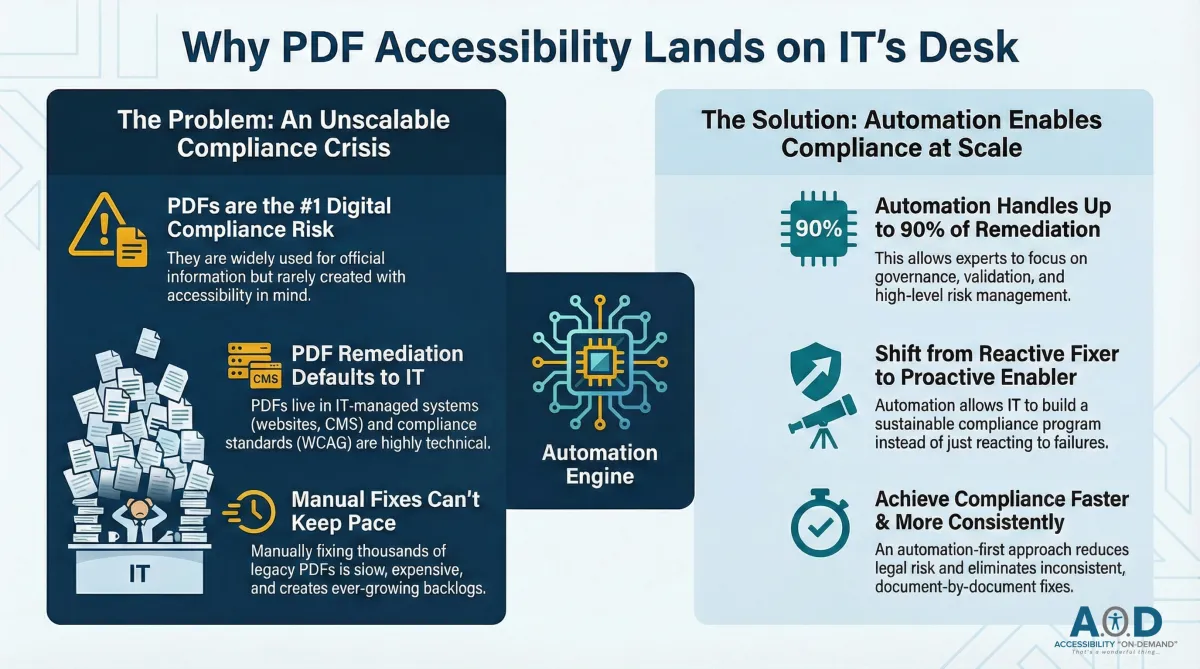
In practice, PDF accessibility remediation almost always becomes an IT responsibility, even when IT did not create the documents. This reality is driven by regulatory mandates, technical enforcement standards, and the sheer scale of inaccessible PDFs across modern organizations.
For IT leaders tasked with ensuring ADA PDF compliance, WCAG-compliant PDFs, or Section 508 document accessibility, understanding why PDFs land on their desk is the first step toward building a sustainable, scalable solution.
PDF Accessibility: The Highest-Risk Area of Digital Compliance
Across government agencies, higher education, healthcare, and enterprise organizations, inaccessible PDFs are one of the most common causes of digital accessibility complaints, audits, and legal actions.
PDFs are high-risk because they are:
Widely used for official and public-facing information
Created by multiple departments without accessibility expertise
Rarely validated against WCAG 2.1 or 2.2 success criteria
Difficult to remediate manually at scale
From public notices and policies to applications, reports, and forms, PDFs often serve as the authoritative source of information. When those documents are not accessible, organizations fail to meet ADA Title II and Title III requirements, Section 508 standards, and equivalent regulations such as AODA.
Why PDF Accessibility Becomes an IT Problem
1. PDFs Live Inside IT-Managed Systems
Although PDFs are created by business units, they are distributed through systems managed by IT, including:
Content management systems (CMS)
Public websites and portals
Document management systems
HR, ERP, and procurement platforms
When an inaccessible PDF is published, the issue is perceived as a technology failure, not a content failure. As a result, IT teams are tasked with ensuring PDF accessibility compliance, regardless of document ownership.
2. Accessibility Standards Are Technical by Design
Most digital accessibility regulations reference WCAG (Web Content Accessibility Guidelines) as the technical standard for compliance. WCAG requirements, such as semantic structure, correct reading order, and compatibility with assistive technologies, are inherently technical.
Because PDF accessibility testing and remediation relies on tools, tagging, and assistive technology validation, accessibility enforcement defaults to IT teams, even when the root cause lies upstream in document creation.
3. PDF Accessibility Fails at Scale
Unlike web pages, PDFs are often created outside controlled development workflows. Organizations may have:
Tens of thousands of legacy PDFs
Scanned or image-based documents
Improperly tagged or untagged files
Inaccessible PDF forms with broken tab order and labels
Manual PDF remediation cannot keep pace with this volume. As a result, IT teams face growing accessibility backlogs that increase compliance risk over time.
The Limitations of Manual PDF Accessibility Remediation
Traditional manual PDF remediation services require specialized expertise, significant time, and high cost per document. While manual remediation may work for a small number of files, it creates serious challenges at scale:
Long turnaround times
Inconsistent accessibility outcomes
Unsustainable remediation costs
Ongoing compliance gaps
For IT teams responsible for enterprise-wide or public-sector accessibility compliance, manual remediation alone is not a viable long-term strategy.
Why Automation Is Critical for PDF Accessibility Compliance
Organizations that successfully manage PDF accessibility at scale adopt an automation-first remediation approach.
At Accessibility on Demand™ (AoD™), we focus on automated PDF accessibility remediation because automation enables IT teams to:
Remediate large volumes of PDFs consistently and predictably
Achieve WCAG, ADA, and Section 508 compliance faster
Reduce reliance on manual, document-by-document fixes
Shift from reactive remediation to proactive accessibility governance
Maintain a high-quality end-user reading experience, not just technical compliance
Automation also allows accessibility to be engineered directly into the remediation process. Through AoD’s proprietary advanced OCR and document capture, consistent AI-driven tagging, and PAC-validated compliance scoring, automated workflows ensure documents are not only compliant, but usable, navigable, and defensible from a risk standpoint.
Automation does not eliminate the need for certified accessibility experts; it makes their work scalable. By performing up to 90% of remediation automatically, automation enables experts to focus on governance, validation, and risk management, an unavoidable requirement when organizations are facing trillions of legacy PDFs in need of remediation. See our blog The 2.5 Trillion PDF Problem, listed below.
For IT teams, this shift is the difference between constantly reacting to accessibility issues and building a sustainable, scalable compliance program that can keep pace with organizational growth.
As a result, as PDF accessibility shifts from an isolated remediation task to an enterprise risk and compliance concern, the role of IT must evolve as well. When automation removes manual bottlenecks and embeds accessibility into standard workflows, IT is no longer reacting to failures, it is enabling compliance at scale across the organization.
Repositioning IT as an Accessibility Enabler
PDF accessibility should not turn IT into a bottleneck.
With the right PDF accessibility tools, IT teams can:
Enable accessible document workflows across departments
Standardize accessibility output organization-wide
Reduce legal and operational risk
Support long-term digital accessibility compliance
When PDF accessibility remediation is automated and integrated into broader accessibility strategy, IT becomes an enabler of compliance, not the last stop for remediation failures.
Next in the Series
Next in this series, "Why "Tagged PDF" Does Not Mean WCAG Compliant: PDF Accessibility Requirements Explained".
About Accessibility on Demand™
Automation-first by design, not by compromise. Delivering compliance, speed, and cost-savings in one solution.
Accessibility on Demand™ (AoD™) is an enterprise-grade, automation-first, AI-powered PDF remediation platform with third-party PAC-verified compliance scores. Built to streamline document accessibility at scale, AoD™ aligns files to WCAG and PDF/UA standards and supports compliance with Section 508, ADA Title II and III, and AODA requirements through a repeatable, audit-ready remediation workflow.
AoD™ transforms inaccessible PDFs into structured, accessible files in minutes, helping organizations reduce reliance on manual remediation services while lowering total remediation costs. The platform is designed to deliver consistent, measurable, and defensible accessibility outcomes that can stand up to regulatory scrutiny and internal audit review.
Enterprise Capabilities
Seamless integration with existing workflows and IDP stacks.
High-volume batch processing for large files and document repositories.
Third-party validation with WCAG and PDF/UA compliance scoring.
Section 508- and ADA-aligned outputs with audit-ready reporting.
Dedicated account management and enterprise support.
Comprehensive onboarding and platform training.
For Remediation Professionals
AoD™ handles over 95% of the heavy lifting, including automated tagging, reading order, contextual alt-text metadata, and document structure. It delivers a complete tag tree so accessibility specialists can focus on subjective refinements and advanced remediation decisions, rather than repetitive manual work.
Beat the Deadlines: Talk with a PDF Accessibility Specialist
The bar for IT accessibility in the public sector is rising. If your organization is navigating ADA compliance, WCAG requirements, or Section 508 accessibility and struggling to understand what applies to your PDF documents. Discover how AoD™ can ensure your organization stays ahead of accessibility deadlines, clarify scope, risk, and next steps.
If you need help navigating ADA Title II regulations, please reach out to us to book a session: Enterprise Contact Form (opens in new tab)
To Sign-up for a free trial of AoD, visit: Book a Demo (opens in new tab)
Learn More About AoD:
To watch a 3-minute video about our AoD™ Solution, visit our Homepage: Accessibility On Demand (opens in new tab)
AoD’s "IT Leadership Blog" Series:
Accessibility Insights (external link)
Week 1 - “Why PDF Accessibility Lands on IT's Desk"
Week 2 - “Why ‘Tagged PDF’ Does Not Mean WCAG Compliant: PDF Accessibility Requirements Explained"
Week 3 - “The Accessibility Triple Play: What PDF Accessibility Really Means for IT Leaders"
Week 4 - “Enterprise PDF Accessibility at Scale: A Governance Framework for CIOs"
Week 5 - "Manual vs. Automated PDF Accessibility Remediation: Automation Is the Only Model That Scales"
Week 6 - "Decentralized PDFs: A Centralized Accessibility Crisis"
Week 7 - "Third-Party PDFs and Accessibility Compliance: Who Owns the Risk?"
Week 8 - "When Forms Fail, Compliance Follows: The CIO's Hidden Accessibility Liability"
Week 9 - "Designing for Outcomes, Not Scores: The Future of PDF Accessibility Leadership"
Week 10 - “Stop Remediating PDFs. Build a Sustainable PDF Accessibility Program Instead."
Week 11 - "IT Is Not the Digital Accessibility Compliance Bottleneck. The DOJ Extension Gives CIOs Time to Prove It."
Week 12 - "Source Remediation vs. The HTML-Transcript Approach. Seven Dimensions That Determine Legal Exposure."
External Links to Other Great AoD Blogs You Don't Want to Miss:
Blog: "The 2.5 Trillion PDF Problem" (opens in new tab)
Blog: "Breaking the PDF Barrier: How Your Agency Can Beat ADA Compliance Costs" (opens in new tab)
Blog: "Understanding ADA Title II Exceptions" (opens in new tab)
External Links to Additional Resources:
W3C: Web Content Accessibility Guidelines (WCAG) 2.1 (opens in new tab)
Section 508 Standards: https://www.section508.gov/ (opens in new tab)
ADA: Exceptions (opens in new tab)
First Steps Toward Compliance:https://www.ada.gov/resources/web-rule-first-steps/ (opens in new tab)
DOJ Title II Web Accessibility Final Rule: https://www.ada.gov/resources/2024-03-08-web-rule/ (opens in new tab)
