Third-Party PDFs and Accessibility Compliance: Who Owns the Risk? | AoD™
WEEK 7 | IT LEADERSHIP BLOG SERIES
Vendor-Created Content Is Your Responsibility, How to Manage It Without the Chaos
Accessibility on Demand™ has built a solution to one of the hardest unsolved problems in enterprise accessibility: bringing vendor-generated PDF content under the same governed, automated remediation system as internal documents. No one has cracked this end-to-end at scale. That is exactly what we are working to change.
Third-party PDFs are one of the largest and least controlled sources of accessibility risk in the enterprise. They also represent one of the most misunderstood areas of compliance. This is where many well-structured accessibility programs quietly unravel.
The Question Every CIO Asks After Week 6
By Week 6 of this series, most CIOs have accepted a fundamental truth: PDF accessibility is an enterprise systems issue, not a one-time remediation task. Automation, governance, and validation are the only sustainable path to managing accessibility at scale.
Then comes the question that changes everything: what about PDFs we did not create?
Vendor documentation, third-party forms, outsourced reports, consultant deliverables, and externally produced PDFs represent a vast and largely ungoverned surface of compliance exposure. They flow into the organization through procurement, partnerships, and service agreements, and they often land on public-facing websites or in employee-facing systems with no accessibility review whatsoever.
This is not a peripheral concern. It is a structural gap that sits at the intersection of legal liability, operational speed, and IT governance.
·Action Step: Before your next vendor contract renewal, ask a direct question: can this vendor demonstrate WCAG conformance for every PDF they will deliver? If the answer is uncertain, that uncertainty is your compliance exposure.
The Misconception That Creates Vendor Accessibility Risk
A persistent assumption exists across organizations, from procurement to legal to IT: if a vendor created the PDF, accessibility is their responsibility.
From a legal and compliance standpoint, that assumption is incorrect.
Under ADA Title II and Title III, organizations are responsible for ensuring effective communication through the digital content they provide, regardless of who authored the document. The same principle applies under Section 508 for federal agencies and contractors. WCAG conformance is not a question of authorship. It is a question of distribution and access.
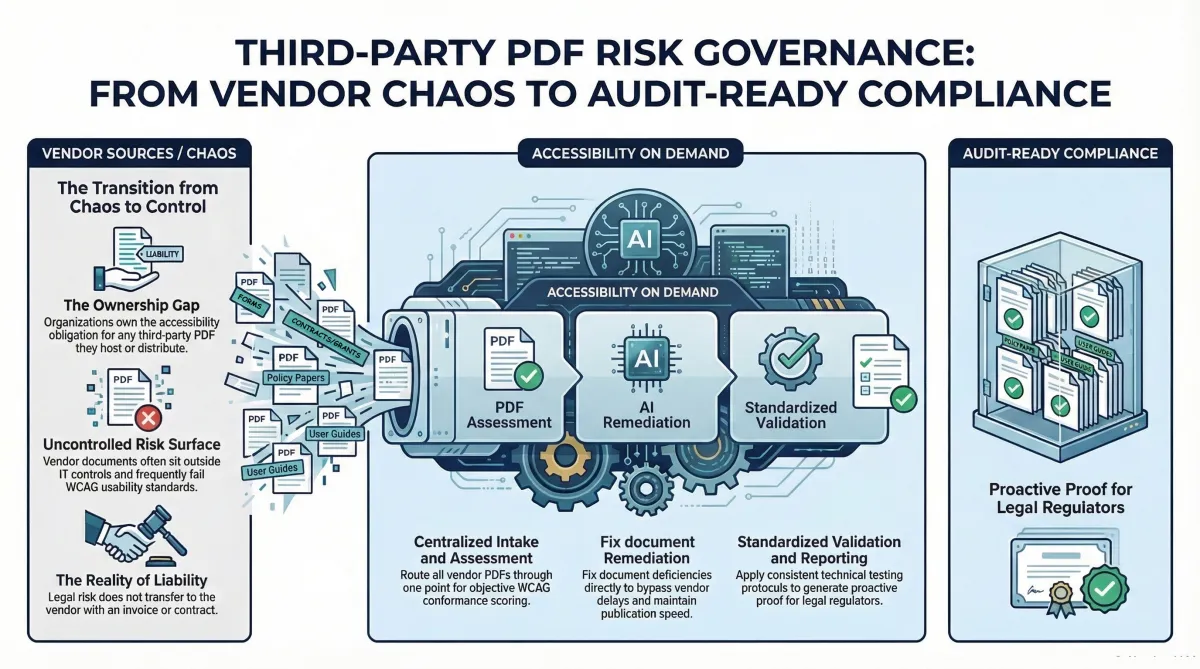
If a third-party PDF is hosted on your website, distributed to your customers or employees, or required to access your services, your organization owns the accessibility obligation. The risk does not transfer with the invoice. The liability does not disappear because the document came from a vendor. The compliance burden does not shift because you contracted the work to someone else.
This creates a challenge that procurement language alone cannot solve, and it is one that catches even mature accessibility programs off guard.
Action Step: Audit your current vendor contracts for accessibility language. Then go one step further: test whether the PDFs those vendors are actually delivering meet the standards the contracts require. In most organizations, there is a significant gap between what was promised and what was delivered.
Vendor PDFs Are a Major Compliance Failure Point
Third-party PDFs introduce accessibility risk because they sit outside normal IT controls. They arrive through procurement channels, not publishing workflows. They are often treated as final deliverables, not content subject to technical review. And they frequently carry an implicit assumption of quality that has no basis in fact.
The operational reality is consistent across industries. Vendors use inconsistent authoring tools, outdated templates, and incomplete tagging practices. Many deliver PDFs labeled as accessible that fail WCAG success criteria for reading order, semantic structure, form field labels, and screen reader usability. IT teams typically encounter these documents late in the process: after procurement, after publication, or after a complaint has already been filed.
At that point, remediation becomes reactive, manual, and politically sensitive. Nobody wants to delay a critical vendor deliverable because of an accessibility review that was never built into the timeline.
This is why vendor PDFs are disproportionately represented in accessibility complaints, audits, and enforcement actions. They fall into the gap between procurement requirements and operational enforcement. Organizations discover too late that the vendor content they trusted is generating the exact compliance exposure they spent months eliminating from their internal documents.
Action Step: Identify the top ten vendor PDFs currently hosted on your website or distributed to users. Run them through an automated WCAG conformance check. The results will tell you immediately whether your vendor accessibility risk is theoretical or active.
Accessibility Responsibility Does Not Stop at Procurement
Vendor contracts may include accessibility language. Many do. Procurement teams have become increasingly sophisticated about requiring WCAG conformance, Section 508 alignment, and PDF/UA compliance in RFPs and master service agreements. This is meaningful progress.
But contractual language does not guarantee conformant PDFs. Contracts establish accountability after the fact. They do not prevent inaccessible documents from reaching users in the meantime.
From a CIO perspective, accessibility responsibility must extend into operational enforcement. Vendor PDFs must be reviewed for WCAG compliance using consistent technical standards, validated before publication or distribution, remediated when deficiencies are found regardless of vendor turnaround time, and governed through repeatable intake processes that prevent non-compliant documents from reaching production.
Without this structure, organizations rely on vendor assurances that are difficult to verify and harder to defend during an audit or enforcement action. The question is not whether vendors should be held accountable. The question is whether IT can afford to wait for vendors to fix accessibility issues when business operations depend on speed.
Action Step: Separate contractual accountability from operational control. Hold vendors accountable through contracts and performance metrics. But do not make your compliance posture dependent on vendor response times. Build the operational capability to validate and remediate vendor content independently.
Manual Vendor Reviews Do Not Scale
Many organizations attempt to manage vendor PDF accessibility through manual review cycles. This typically involves emailing documents back and forth, requesting fixes, waiting weeks for revisions, and rechecking accessibility manually. When vendors push back or miss deadlines, IT becomes caught between business units demanding publication and compliance teams demanding conformance.
This approach fails for the same reason manual remediation fails everywhere else: it does not scale.
As vendor volume increases, review timelines stretch, publication delays grow, and IT becomes the bottleneck. Worse, accessibility enforcement becomes inconsistent. Some PDFs are reviewed thoroughly. Others slip through because deadlines loom or vendor relationships are sensitive.
From a risk perspective, inconsistency is indefensible. Organizations cannot explain to regulators, auditors, or plaintiffs that accessibility enforcement depended on which vendor was easier to negotiate with or which business unit had more urgency.
The only defensible model is one where every vendor PDF is subject to the same technical validation, remediation capability, and documentation standards, without exception and without negotiation.
Action Step: Map your current vendor PDF review process from intake to publication. Identify every manual handoff, every email chain, and every point where the process depends on a person rather than a system. That map is your compliance risk register.
Action Step: Map your current vendor PDF review process from intake to publication. Identify every manual handoff, every email chain, and every point where the process depends on a person rather than a system. That map is your compliance risk register.
How CIOs Manage Vendor PDF Accessibility at Scale
CIO-led organizations treat third-party PDFs the same way they treat internally generated content: as part of a controlled accessibility system. This does not mean treating vendors as adversaries. It means removing accessibility from the realm of negotiation and placing it into the realm of technical validation and automated remediation.
Automation-first accessibility platforms allow IT teams to manage vendor PDFs through repeatable, governed workflows that do not depend on vendor cooperation or manual reviewer availability.
1. Centralized Intake
Vendor PDFs are routed through a centralized intake system before publication or distribution. This removes the ad hoc nature of vendor document management and ensures every third-party PDF passes through the same validation pipeline, regardless of which team received it or which vendor produced it.
2. Automated WCAG Conformance Assessment
Instead of manual checks that depend on individual expertise and availability, automation-first platforms assess WCAG conformance consistently. Every vendor PDF is evaluated against the same technical success criteria, producing objective, audit-ready scoring that does not vary by reviewer or deadline pressure.
3. Remediation Without Vendor Dependency
When accessibility deficiencies are identified, IT can remediate vendor PDFs directly without waiting for vendor turnaround. This eliminates the cycle of back-and-forth revision requests, missed deadlines, and delayed publications. Vendors can still be held accountable through contractual language and performance metrics. But publication timelines no longer depend on vendor responsiveness.
4. Standardized Validation and Documentation
Every remediated vendor PDF is validated using consistent testing protocols. Documentation is generated automatically, providing audit-ready proof that vendor content was reviewed, assessed, and brought into conformance before reaching users. This is the evidence layer that protects the organization during audits and enforcement actions.
5. Audit-Ready Reporting
IT can demonstrate to legal teams, auditors, and regulators that vendor PDFs are subject to the same governance controls as internal documents. This shifts the organization from reactive explanation to proactive compliance posture, which is precisely the position regulators want to see.
Action Step: Evaluate your current accessibility tooling specifically against vendor PDF workflows. If your platform requires manual intervention at any stage of the vendor intake and remediation process, that manual step is your scaling ceiling.
Shifting Vendor Accessibility from Friction to Governance
The goal is not to create adversarial vendor relationships. The goal is to remove ambiguity from a process that has historically depended on goodwill, negotiation, and individual follow-through.
When accessibility requirements are enforced through automated validation and remediation, vendors receive clear, technical feedback. IT maintains control over timelines and compliance outcomes. Business units are not delayed waiting for vendor rework cycles. And the organization is no longer in the position of explaining inconsistent enforcement to a regulator.
This mirrors how CIOs already manage security scans, data handling standards, and vendor compliance controls across the enterprise. Accessibility belongs in the same category: a non-negotiable technical standard that is validated before content enters production, every time, without exception.
Vendors who consistently deliver accessible PDFs benefit from faster review cycles. Vendors who do not receive clear, technical feedback that supports improvement. Either way, the organization is protected, and the compliance record is clean.
Action Step: Position vendor PDF accessibility as a technical standard in your next vendor governance review, alongside security scanning, data classification, and API compliance. It belongs in the same operational category.
What Regulators and Auditors Expect to See
In accessibility reviews and enforcement actions, regulators rarely ask who created the document. They ask whether the PDF was accessible, whether the accessibility risk was known, whether there was a process to address it, and whether the organization can demonstrate control.
Organizations that can show systematic vendor PDF review, remediation, and validation are in a substantially stronger position than those relying on contractual disclaimers or reactive fixes after complaints are filed.
Audit-ready documentation that demonstrates consistent governance over vendor content is the difference between a defensible compliance program and a reactive explanation that satisfies no one. Regulators have seen the contractual disclaimer defense before. It does not work.
Action Step: Ask your legal team directly: if a regulator reviewed our vendor PDF governance today, what would we be able to show them? If the answer involves email chains, manual spreadsheets, or vendor assurances, the answer is not sufficient.
Practical Action Items: Managing Vendor PDFs Without the Chaos
For CIOs and IT accessibility leaders ready to bring vendor PDFs under governance control, the following action items provide a structured starting point.
Action Item 1: Conduct a Vendor PDF Inventory
Identify all third-party PDFs currently hosted on your website, distributed to customers or employees, or required to access services. Categorize by vendor, usage frequency, and compliance risk using a tiered model based on user impact. Tier 1 documents, those that are customer-facing, high-usage, or gating essential services, require immediate prioritization.
Timeframe: 2 to 4 weeks
Output: Complete inventory with risk classification
Action Item 2: Establish a Centralized Intake Process
Create a single intake point for all vendor PDFs before publication or distribution. This removes ad hoc document routing and ensures every third-party document passes through accessibility validation before it reaches users. Stakeholder alignment across procurement, legal, and IT is essential to make this stick operationally.
Timeframe: 1 to 2 weeks
Output: Documented intake workflow with stakeholder alignment
Action Item 3: Deploy Automated WCAG Assessment
Implement an automation-first platform to assess vendor PDFs for WCAG conformance. This replaces manual, inconsistent reviews with objective, repeatable validation that produces the same result regardless of who is reviewing, when, or under what deadline pressure.
Timeframe: 2 to 4 weeks
Output: Automated assessment capability with compliance scoring
Action Item 4: Remediate High-Risk Vendor PDFs First
Prioritize remediation of Tier 1 vendor PDFs: customer-facing documents, high-usage content, and PDFs required to access critical services. Use automation to remediate without waiting on vendor rework cycles. This is where the compliance exposure is highest and where the operational value of automation is most immediate.
Timeframe: 4 to 8 weeks
Output: Tier 1 vendor PDFs brought into WCAG conformance
Action Item 5: Generate Audit-Ready Documentation
Establish automated reporting that documents vendor PDF assessment, remediation, and validation for every document that passes through the intake pipeline. This provides legal teams and auditors with proof of systematic governance, not anecdotal explanations.
Timeframe: Ongoing
Output: Audit-ready vendor accessibility reports
The CIO Takeaway: Vendor PDFs Are Not an Edge Case
Third-party PDFs are not a peripheral concern. They are a primary source of accessibility exposure in most enterprise organizations, and they are almost always operating outside IT governance at the moment this series reaches CIO desks.
CIOs who extend accessibility governance to vendor content eliminate one of the last uncontrolled variables in their compliance posture. When vendor PDFs are treated as part of the accessibility system, not exceptions to it, IT stops reacting to risk and starts managing it with the same rigor applied to internal documents.
The organizations that succeed in this area do not negotiate accessibility with every vendor on a case-by-case basis. They build systems that validate, remediate, and govern vendor content the same way they manage everything else. This is not about perfection. It is about defensible control at scale.
The Strategic Win: from Vendor Dependency to IT Control
When vendor PDF accessibility is managed through automation-first platforms, the operational outcomes are concrete and measurable. IT is no longer dependent on vendor timelines for compliance decisions. Business units are no longer delayed by accessibility rework cycles that were never planned for. Legal teams gain defensible documentation of vendor content governance. And regulators and auditors see systematic control rather than ad hoc explanations.
Vendor PDFs stop being a compliance blind spot and become part of a governed, repeatable accessibility system. That shift, from reactive liability to proactive control, is one of the clearest wins available to CIOs who approach accessibility as an enterprise systems problem rather than a document-by-document remediation task.
Next in the Series
Look for Week 8 in our 12-part IT Leadership Blog series: "When Forms Fail, Compliance Follows: The CIO's Hidden Accessibility Crisis".
About Accessibility on Demand™
Automation-first by design, not by compromise.
Accessibility on Demand™ (AoD™) is an enterprise-grade, automation-first PDF accessibility remediation platform. AoD™ aligns documents to WCAG and PDF/UA standards and supports compliance with Section 508, ADA Title II and III, and AODA requirements through a scalable, repeatable remediation framework.
The platform converts inaccessible PDFs into structured, audit-ready files in minutes, reducing dependency on manual services and significantly lowering total remediation costs. AoD™ provides organizations with measurable, consistent, and defensible accessibility outcomes suitable for regulatory scrutiny and internal audit review.
AoD™ Enterprise Capabilities:
Seamless integration with existing workflows and IDP stacks
High-volume batch processing for large files and document repositories
Third-party validation with WCAG and PDF/UA compliance scoring
Section 508 and ADA-aligned outputs with audit-ready reporting
Dedicated account management and enterprise support
Comprehensive onboarding and platform training
For Remediation Professionals:
AoD™ handles 90% of the heavy lifting (automated tagging, reading order, metadata, and structure) and delivers a complete tag tree, so accessibility specialists can still make subjective refinements and advanced remediation decisions where needed, rather than spending time on repetitive manual work.
Beat the Deadlines: Talk with a PDF Accessibility Specialist
The bar for IT accessibility in the public sector is rising. If your organization is navigating ADA compliance, WCAG requirements, or Section 508 accessibility and struggling to understand what applies to your PDF documents. Discover how AoD™ can ensure your organization stays ahead of accessibility deadlines, clarify scope, risk, and next steps.
External Links to Learn More About AoD:
To watch a 3-minute video about our AoD™ Solution, visit our Homepage: Accessibility On Demand (opens in new tab)
If you need help navigating ADA Title II regulations, please reach out to us to book a session:
Enterprise Contact Form (opens in new tab)
To Sign-up for a free trial of AoD, visit: Book a Demo (opens in new tab)
External Links to AoD’s "IT Leadership Blog" Series:
Week 1 - “Why PDF Accessibility Lands on IT's Desk" (opens in new tab)
Week 4 - “Enterprise PDF Accessibility at Scale: A Governance Framework for CIOs" (opens in new tab)
Week 6 -"Decentralized PDFs: A Centralized Accessibility Crisis" (opens in new tab)
External Links to Other Great AoD Blogs You Don't Want to Miss:
Blog: "The 2.5 Trillion PDF Problem" (opens in new tab)
Blog: "Breaking the PDF Barrier: How Your Agency Can Beat ADA Compliance Costs" (opens in new tab)
Blog: "Understanding ADA Title II Exceptions" (opens in new tab)
External Links to Additional Resources:
W3C: Web Content Accessibility Guidelines (WCAG) 2.1 (opens in new tab)
Section 508 Standards: https://www.section508.gov/ (opens in new tab)
ADA: Exceptions (opens in new tab)
First Steps Toward Compliance: https://www.ada.gov/resources/web-rule-first-steps/ (opens in new tab)
DOJ Title II Web Accessibility Final Rule: https://www.ada.gov/resources/2024-03-08-web-rule/ (opens in new tab)
