Decentralized PDFs: A Centralized Accessibility Crisis | AoD™
WEEK 6 | IT LEADERSHIP BLOG SERIES
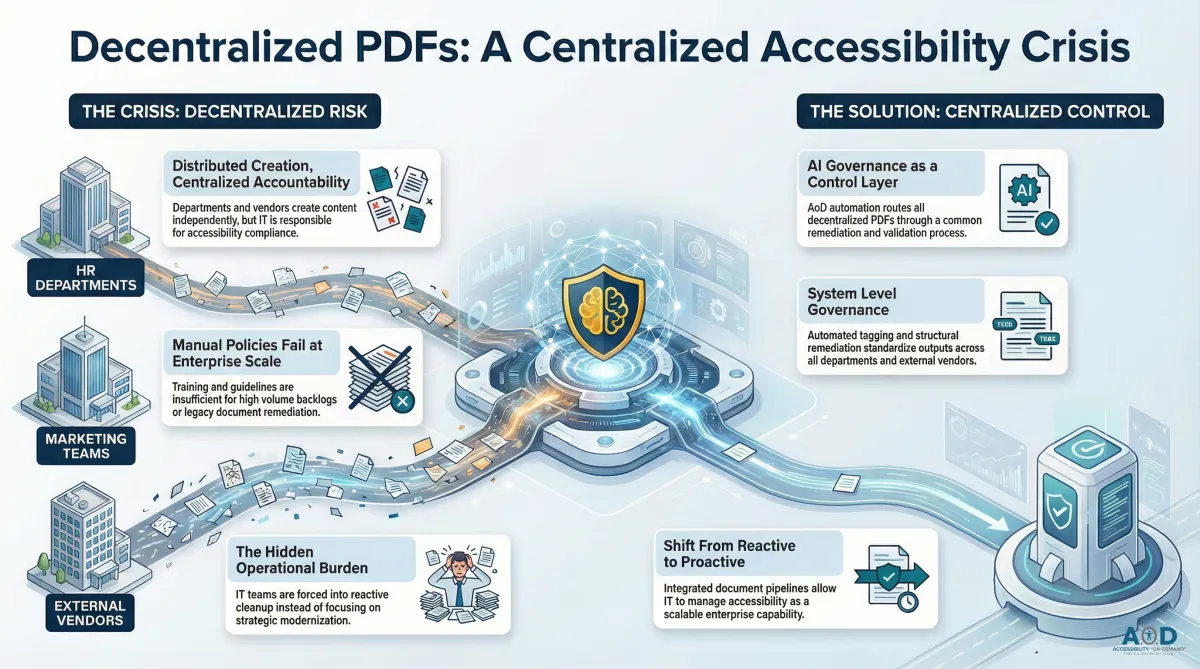
Decentralized Creation, Centralized Accountability
In most organizations, PDF documents are created across multiple departments, systems, and vendors. Marketing publishes brochures, HR distributes policies, finance shares reports, procurement uploads contracts, and third parties submit their own files. While PDF creation is decentralized, PDF accessibility compliance risk is not. When PDFs fail to meet WCAG, ADA, or Section 508 accessibility requirements, accountability ultimately lands with IT.
CIOs understand this operational reality. Content creation is intentionally distributed to enable speed and autonomy, while risk management, regulatory compliance, and accessibility governance remain centralized responsibilities. When accessibility complaints arise or enforcement actions occur, regulators do not evaluate which department created the document. They evaluate whether the organization provided accessible digital content. This is how decentralized PDF creation becomes centralized accessibility risk.
When Policies Meet Real‑World Scale
Many organizations attempt to manage PDF accessibility through policies, training programs, or authoring guidelines. These efforts are necessary, but they are not sufficient at enterprise scale. Departments use different document tools, accessibility knowledge varies by role, staff turnover erodes consistency, vendors deliver PDFs with unknown accessibility quality, and legacy documents persist across repositories.
Without automated PDF accessibility remediation and validation, policies become advisory rather than enforceable. For CIOs, that gap introduces measurable compliance risk and a growing backlog of inaccessible PDFs that no team can reasonably remediate by hand. The result is familiar: IT inherits the problem, compliance worries about exposure, and the business wonders why something that sounds so simple is so hard to operationalize.
The Hidden Cost CIOs Live With
Inconsistent PDF accessibility creates downstream operational and legal challenges that CIOs feel every budget cycle:
IT teams are forced into reactive PDF remediation instead of strategic modernization work.
Compliance teams lack reliable accessibility reporting and cannot quantify risk.
Legal teams face uncertainty around ADA and WCAG exposure and potential enforcement.
Business units experience delays and rework when PDFs fail accessibility checks late in the process.
End users encounter inconsistent access to information and submit more accommodation requests.
These failures are not the result of poor intent. They are the result of systems that do not enforce accessibility standards at scale, across decentralized document creation and across time.
Accessibility on Demand: A Central Methodology for a Decentralized World
Accessibility on Demand (AoD) provides a centralized methodology that matches how CIOs already think about enterprise governance. AoD routes all decentralized PDF creation through an automation-first platform that becomes the accessibility control layer for the organization. Regardless of who creates a PDF or which vendor delivers it, the document flows through a common remediation and validation process.
Through automated OCR, AI driven tagging, structural remediation, and PAC validated compliance scoring, accessibility standards are enforced as part of the document lifecycle. AoD standardizes PDF accessibility outputs across departments, tools, and vendors without requiring every contributor to be an accessibility expert. This is not workflow assistance. This is accessibility governance at the system level.
What CIOs Are Actually Facing: Real‑World Scenarios
CIOs are not dealing with theoretical risk. They are facing a mix of deadlines, legacy content, and fragmented tools. AoD fits into that reality, not around it.
State and Local Government: Backlogs and Deadlines
State agencies, cities, and counties are staring at ADA Title II expectations, Section 508 alignment, and websites filled with years of PDFs published by many departments. Manual remediation estimates balloon into multi-year projects and multi-million-dollar budgets. The practical question becomes: how do we reduce this backlog without halting new content?
With AoD, CIOs can triage and remediate large PDF inventories using automation-first PDF accessibility remediation. Legacy forms, policies, agendas, and reports can be ingested in batches, auto tagged, and validated against WCAG PDF accessibility standards, with reports that prove progress. Instead of choosing between “fix everything” and “do nothing,” AoD enables a risk based, measurable path forward that shows steady reduction in non-compliant PDFs.
Higher Education and K‑12: Decentralized Authors, Centralized Risk
Public universities, community colleges, and school districts often have the most decentralized PDF ecosystems. Faculty upload syllabi, curriculum teams publish resources, administrators share policies, and disability services teams are asked to “just fix” whatever students identify as inaccessible.
AoD can sit behind learning management systems, portals, and repositories as an “accessibility on demand” service. When a PDF is uploaded, it is automatically assessed and remediated to meet PDF accessibility compliance. Over time, the institution can bulk remediate older content while ensuring that new PDFs enter the ecosystem in an accessible state. CIOs move from firefighting around individual student complaints to running a predictable, transparent PDF accessibility operation that aligns with equity and inclusion goals.
Federal and Large Agencies: High Visibility, High Scrutiny
Federal agencies and large regulatory bodies publish complex, data rich PDF reports that must stand up to both public scrutiny and internal audits. Tables, charts, and multi-column layouts make manual tagging expensive and slow. Yet these same documents are often the ones cited in Section 508 reviews and accessibility audits.
In these environments, AoD acts as a centralized PDF accessibility service within secure infrastructure. Complex PDFs can be processed at scale with automated remediation and PAC validated outputs, while accessibility specialists focus on quality assurance rather than repetitive tagging. CIOs gain audit ready evidence that published PDFs meet WCAG PDF accessibility and Section 508 requirements, and they can answer “how do we know” with concrete data instead of assumptions.
Counties and Municipalities: Many Departments, One Standard
Counties and municipalities often have dozens of sites, microsites, and portals managed by different teams. Vendor supplied PDFs for permits, contracts, and forms enter the system with unknown accessibility quality. Residents with disabilities experience the inconsistency first.
AoD gives CIOs a straightforward model. Any PDF that is destined for public publication flows through the automation-first accessibility pipeline. Departments keep their autonomy, but the PDFs they publish are held to the same accessibility standard. Vendors are no longer trusted blindly; their PDFs are validated and remediated before posting. The result is a consistent, citizen centric digital experience that also reduces legal and reputational risk.
Shifting IT from Cleanup to Control
When PDF accessibility relies on manual intervention, IT becomes the last stop for remediation failures. Requests pile up, deadlines compress, and teams are forced into reactive prioritization. This pattern is unsustainable, and CIOs know it.
When accessibility is automated and integrated into document pipelines through AoD, IT becomes the control point. PDFs are assessed and remediated before reaching users. Accessibility metrics become part of standard reporting alongside uptime, security, and performance. This shift reduces emergency remediation, stabilizes compliance posture, and aligns PDF accessibility with the broader enterprise IT governance model.
In practice, this looks like:
Automated PDF accessibility checks at upload or publication time.
Standard accessibility scores and reports for leadership and auditors.
Clear service levels for remediation that do not depend on heroic manual effort.
Third‑Party PDFs: From Blind Spot to Managed Input
Vendor and third-party PDFs often represent the greatest accessibility exposure because they bypass internal creation standards. Contracts and submissions may arrive in inaccessible formats, yet the obligation to provide accessible content remains with the organization.
AoD closes this gap by treating third party PDFs like any other high-risk input. Vendor documents are routed through the same automation-first remediation service, validated for WCAG and ADA compliance, and only then surfaced to the public or internal users. CIOs can still use contracts to set expectations, but they no longer rely on promises alone. Accessibility is verified, not assumed.
The CIO Mandate: Systems, Not Heroics
CIOs are not responsible for manually fixing every PDF. They are responsible for ensuring that systems do not allow inaccessible content to create ongoing compliance risk. That distinction is where AoD delivers its real value.
An automation-first approach to PDF accessibility transforms decentralized content creation into centralized, auditable, and scalable risk management. It is not about replacing people; it is about giving people systems that make accessibility the default state of digital content.
Strategic Takeaway: Accessibility as an Enterprise Capability
PDF accessibility does not fail because people ignore standards. It fails because systems lack enforcement and governance. CIOs who adopt automated PDF accessibility remediation through an Accessibility on Demand model stop chasing individual documents and start managing accessibility as an enterprise capability.
When accessibility is automated and centralized through AoD, decentralized creation no longer means decentralized risk. It means governed, compliant scale, with PDF accessibility integrated into the same strategic framework that already guides security, data, and infrastructure.
Next in the Series
Look for Week 7 in our 12-part IT Leadership Blog series: "Third-Party PDFs and Accessibility Compliance: Who Owns the Risk?". Learn why Vendor-Created Content Is Your Responsibility (And How to Manage It Without the Chaos).
About Accessibility on Demand™
Automation-first by design, not by compromise.
Accessibility on Demand™ (AoD™) is an enterprise-grade, automation-first PDF accessibility remediation platform. AoD™ aligns documents to WCAG and PDF/UA standards and supports compliance with Section 508, ADA Title II and III, and AODA requirements through a scalable, repeatable remediation framework.
The platform converts inaccessible PDFs into structured, audit-ready files in minutes, reducing dependency on manual services and significantly lowering total remediation costs. AoD™ provides organizations with measurable, consistent, and defensible accessibility outcomes suitable for regulatory scrutiny and internal audit review.
AoD™ Enterprise Capabilities:
Seamless integration with existing workflows and IDP stacks
High-volume batch processing for large files and document repositories
Third-party validation with WCAG and PDF/UA compliance scoring
Section 508 and ADA-aligned outputs with audit-ready reporting
Dedicated account management and enterprise support
Comprehensive onboarding and platform training
For Remediation Professionals:
AoD™ handles 90% of the heavy lifting (automated tagging, reading order, metadata, and structure) and delivers a complete tag tree, so accessibility specialists can still make subjective refinements and advanced remediation decisions where needed, rather than spending time on repetitive manual work.
Beat the Deadlines: Talk with a PDF Accessibility Specialist
The bar for IT accessibility in the public sector is rising. If your organization is navigating ADA compliance, WCAG requirements, or Section 508 accessibility and struggling to understand what applies to your PDF documents. Discover how AoD™ can ensure your organization stays ahead of accessibility deadlines, clarify scope, risk, and next steps.
External Links to Learn More About AoD:
To watch a 3-minute video about our AoD™ Solution, visit our Homepage: Accessibility On Demand (opens in new tab)
If you need help navigating ADA Title II regulations, please reach out to us to book a session:
Enterprise Contact Form (opens in new tab)
To Sign-up for a free trial of AoD, visit: Book a Demo (opens in new tab)
External Links to AoD’s "IT Leadership Blog" Series:
Week 1 - “Why PDF Accessibility Lands on IT's Desk" (opens in new tab)
Week 4 - “Enterprise PDF Accessibility at Scale: A Governance Framework for CIOs" (opens in new tab)
A PEAK AHEAD
Week 7 - "Third Party PDFs and Accessibility Compliance: Who Owns the Risk?" (opens in new tab)
External Links to Other Great AoD Blogs You Don't Want to Miss:
Blog: "The 2.5 Trillion PDF Problem" (opens in new tab)
Blog: "Breaking the PDF Barrier: How Your Agency Can Beat ADA Compliance Costs" (opens in new tab)
Blog: "Understanding ADA Title II Exceptions" (opens in new tab)
External Links to Additional Resources:
W3C: Web Content Accessibility Guidelines (WCAG) 2.1 (opens in new tab)
Section 508 Standards: https://www.section508.gov/ (opens in new tab)
ADA: Exceptions (opens in new tab)
First Steps Toward Compliance:https://www.ada.gov/resources/web-rule-first-steps/ (opens in new tab)
DOJ Title II Web Accessibility Final Rule: https://www.ada.gov/resources/2024-03-08-web-rule/ (opens in new tab)
