The Accessibility Triple Play: What PDF Accessibility Really Means for IT Leaders | AoD™
WEEK 3 | IT LEADERSHIP BLOG SERIES
Navigating Today's Compliance Landscape - the runway is short
ADA, WCAG, and Section 508
By now you are most likely aware of the looming ADA Title II Compliance Deadlines facing state and local government entities, including public universities, K-12 schools, counties, and cities. Our blog Understanding ADA Title II Exceptions" outlines the details (link provided below)..
Private enterprises, subject to ADA Title III with no formal deadline, are NOT off the hook. Private businesses face real and ongoing litigation risk via lawsuits, DOJ investigations, and demand letters, even in the absence of a formal DOJ deadline. The 2026 ADA Title II deadline signals where enforcement is headed, and courts are already using WCAG 2.1 AA as the standard in private-sector cases.
Beyond the deadlines themselves, PDF accessibility regulations often feel like a maze of disconnected requirements.
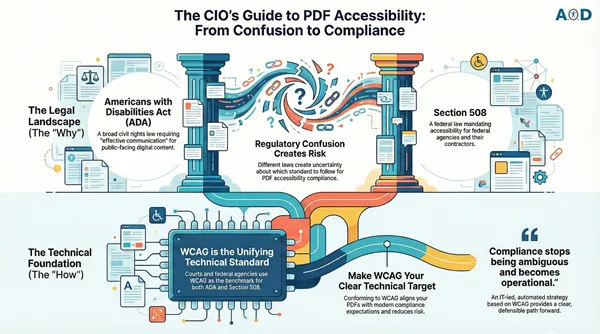
The ADA references "effective communication" without specifying technical standards.
Section 508 mandates accessibility for federal agencies but doesn't detail how to achieve it.
WCAG provides the actual technical specifications, yet it's rarely cited directly in U.S. legislation.
For CIOs and IT leaders, this isn't just confusing, it's a compliance risk. Without clarity on how these regulations intersect, organizations struggle to build defensible PDF remediation strategies, assess their true legal obligations, or move beyond reactive, ad-hoc fixes.
Yet, it's simpler than it looks. WCAG serves as the technical foundation for PDF accessibility enforcement under both the ADA and Section 508.
Once you understand how these three frameworks connect, you can shift from fragmented compliance efforts to a unified, governed accessibility program that actually scales.
Mastering Multi-Front Compliance - the Accessibility Triple Play
Most organizations encounter three primary accessibility frameworks when managing accessible PDFs:
Americans with Disabilities Act (ADA)
Section 508 of the Rehabilitation Act
Web Content Accessibility Guidelines (WCAG)
The ADA applies broadly to public-facing digital content. While it does not name WCAG compliance explicitly, courts and enforcement agencies consistently use WCAG standards as the benchmark for determining whether digital documents, including PDF documents, are accessible. For state and local governments, ADA Title II enforcement has intensified, particularly around online forms, public records, and government PDFs.
Section 508 is more prescriptive. It applies to federal agencies and organizations doing business with the federal government. Section 508 accessibility requirements explicitly incorporate WCAG 2.1, making WCAG conformance a legal obligation rather than a recommendation.
WCAG itself is not law. It is a technical accessibility standard developed by the World Wide Web Consortium (W3C). However, it has become the de facto compliance framework used to evaluate PDF accessibility under both ADA enforcement and Section 508 enforcement.
For IT leaders, this means one thing: if your PDFs do not conform to WCAG, they are unlikely to meet ADA compliance or Section 508 compliance expectations.
The Accessibility Gap: When Tagged PDFs Still Fail Users
WCAG guidelines define how digital content accessibility must function for people using assistive technologies, including screen readers. In the context of PDF accessibility, WCAG addresses reading order, document structure, headings, lists, tables, form field labels, alternative text, color contrast, and keyboard navigation.
A PDF can appear visually correct and still fail WCAG success criteria. Tagged PDFs alone do not guarantee PDF accessibility compliance. If the tag structure is incorrect, reading order is broken, or PDF forms lack proper labels, the document remains inaccessible and non-compliant.
From an enforcement perspective, regulators and plaintiffs do not assess intent. They assess usability. WCAG conformance provides the measurable criteria used to determine whether a PDF document actually works for screen reader users.
Intent vs Usability - see Week 2's blog "Why 'Tagged PDF' Does Not Mean WCAG Compliant". See link below.
You Don't Need a Law Degree to Fix PDF Accessibility
CIOs often assume they must become legal experts to manage accessibility risk. That is not the case. IT does not need to interpret legislation or predict enforcement trends. What IT needs is a clear technical standard and a repeatable method for achieving PDF accessibility compliance.
The technical target is WCAG compliance. The operational requirement is consistency. If PDF documents are created, remediated, and validated against WCAG accessibility standards, organizations are aligned with current ADA and Section 508 requirements.
The complexity arises when accessibility remediation is treated as a one-time project rather than an ongoing governance control. Without governance, new PDFs introduce recurring accessibility compliance risk.
Prioritize What Matters: Building a Smarter PDF Accessibility Strategy
Accessibility regulations do not require every legacy PDF to be remediated immediately. They require reasonable access, documented prioritization, and demonstrable progress toward digital accessibility compliance.
Prioritization determines which PDFs to remediate first. WCAG compliance determines how they must be remediated to actually work for users with disabilities.
Effective IT-led accessibility programs focus first on high-risk PDFs: public-facing PDFs, customer and employee forms, regulated disclosures, and documents tied to essential services. Automation-first PDF remediation enables these documents to be remediated at scale and validated for WCAG compliance.
At the same time, accessibility controls must be enforced upstream. If new PDFs are created without automated accessibility validation, the backlog never shrinks. Regulations may trigger action, but accessibility governance sustains compliance.
Your PDF Accessibility Problem Is Really a Systems Problem
Why PDF accessibility often lands on IT's desk is simple: it impacts every part of the enterprise - document systems, content workflows, automation infrastructure, and compliance reporting. Legal and compliance teams may define obligations, but CIOs determine whether accessibility requirements are technically achievable at scale.
CIO-led programs succeed because they treat PDF accessibility as a systems problem, not a manual service. Automation-first accessibility platforms allow IT to inventory PDFs, assess WCAG conformance, remediate efficiently, and generate audit-ready accessibility reporting. This approach replaces uncertainty with visibility and replaces reactive fixes with controlled compliance execution.
The Bottom Line for IT Leaders - Turning Regulatory Confusion into Strategic Clarity
ADA, WCAG, and Section 508 are not competing standards. WCAG is the technical foundation used to enforce the others. When PDF documents meet WCAG requirements, organizations are aligned with modern accessibility compliance expectations.
For CIOs and accessibility leaders, the goal is not to chase regulations, it is to implement a scalable PDF accessibility strategy that reduces risk, supports users, and stands up to procurement and audit scrutiny.
To achieve operational accessibility, IT leaders should prioritize capabilities such as:
WCAG, PDF/UA, and Section 508 compliant outputs
Audit-ready compliance scoring and reporting
Reliable reading order determination to eliminate high-risk failures
Automation-first PDF accessibility remediation for cost control and consistency
Scalability across enterprise and public-sector volumes
Support for complex tables, lists, links, and long-form documents
Exception-based review workflows that limit manual intervention
Automated accessibility metadata applied by default
Context-aware alternative text that improves real usability
Organizations evaluating accessibility solutions should prioritize platforms that combine compliance, automation, and scalability, ensuring both regulatory alignment and enterprise-ready implementation.
This is where AoD™ delivers value: by turning the capabilities outlined above into an operational system that scales across enterprise volumes, produces audit-ready documentation, and reduces manual remediation costs. When PDF accessibility is automated and validated at the source, compliance becomes a repeatable process, not a perpetual project.
Next in the Series
We hope you are enjoying AoD’s 12-week educational series. Look for next week’s blog, week 4 in the series, “Enterprise PDF Accessibility at Scale: Governance Framework for CIOs”.
About Accessibility on Demand™
Automation-first by design, not by compromise.
Accessibility on Demand™ (AoD™) is an enterprise-grade, automation-first PDF accessibility remediation platform. AoD™ aligns documents to WCAG and PDF/UA standards and supports compliance with Section 508, ADA Title II and III, and AODA requirements through a scalable, repeatable remediation framework.
The platform converts inaccessible PDFs into structured, audit-ready files in minutes, reducing dependency on manual services and significantly lowering total remediation costs. AoD™ provides organizations with measurable, consistent, and defensible accessibility outcomes suitable for regulatory scrutiny and internal audit review.
AoD™ Enterprise Capabilities:
Seamless integration with existing workflows and IDP stacks
High-volume batch processing for large files and document repositories
Third-party validation with WCAG and PDF/UA compliance scoring
Section 508 and ADA-aligned outputs with audit-ready reporting
Dedicated account management and enterprise support
Comprehensive onboarding and platform training
For Remediation Professionals:
AoD™ handles 90% of the heavy lifting (automated tagging, reading order, metadata, and structure) and delivers a complete tag tree, so accessibility specialists can still make subjective refinements and advanced remediation decisions where needed, rather than spending time on repetitive manual work.
Beat the Deadlines: Talk with a PDF Accessibility Specialist
The bar for IT accessibility in the public sector is rising. If your organization is navigating ADA compliance, WCAG requirements, or Section 508 accessibility and struggling to understand what applies to your PDF documents. Discover how AoD™ can ensure your organization stays ahead of accessibility deadlines, clarify scope, risk, and next steps.
External Links to Learn More About AoD:
To watch a 3-minute video about our AoD™ Solution, visit our Homepage: Accessibility On Demand (opens in new tab)
If you need help navigating ADA Title II regulations, please reach out to us to book a session:
Enterprise Contact Form (opens in new tab)
To Sign-up for a free trial of AoD, visit: Book a Demo (opens in new tab)
External Links to AoD’s "IT Leadership Blog" Series:
Week 1 - “Why PDF Accessibility Lands on IT's Desk" (opens in new tab)
A PEAK AHEAD:
Week 4 - “Enterprise PDF Accessibility at Scale: A Governance Framework for CIOs" (opens in new tab)
Week 6 - "Decentralized PDFs: A Centralized Accessibility Crisis" (opens in a new tab)
Week 7 - "Third Party PDFs and Accessibility Compliance: Who Owns the Risk?" (opens in new tab)
External Links to Other Great AoD Blogs You Don't Want to Miss:
Blog: "The 2.5 Trillion PDF Problem" (opens in new tab)
Blog: "Breaking the PDF Barrier: How Your Agency Can Beat ADA Compliance Costs" (opens in new tab)
Blog: "Understanding ADA Title II Exceptions" (opens in new tab)
External Links to Additional Resources:
W3C: Web Content Accessibility Guidelines (WCAG) 2.1 (opens in new tab)
Section 508 Standards: https://www.section508.gov/ (opens in new tab)
ADA: Exceptions (opens in new tab)
First Steps Toward Compliance:https://www.ada.gov/resources/web-rule-first-steps/ (opens in new tab)
DOJ Title II Web Accessibility Final Rule: https://www.ada.gov/resources/2024-03-08-web-rule/ (opens in new tab)
