Enterprise PDF Accessibility at Scale: A Governance Framework for CIOs | AoD™
WEEK 4 | IT LEADERSHIP BLOG SERIES
Beyond Cleanup: Treating PDF Accessibility as Governance and Risk Management
Enterprise PDF accessibility is often approached as a document cleanup project. At scale, it is not a document problem. It is a governance and risk management problem.
Large organizations often manage hundreds of thousands of PDF files across public websites, internal employee portals, procurement systems, and regulated service environments. According to industry analyses of enterprise content repositories, it is common for organizations to have 100,000 to 500,000 PDFs or more, especially in sectors like government, higher education, healthcare, and financial services.
Many of these PDFs are short-form documents averaging 3 to 10 pages, while technical manuals, policy guides, and regulatory disclosures frequently exceed 50 pages in length. At that scale, an enterprise with 100,000 documents could easily be responsible for upwards of 300,000 pages, and larger inventories can reach millions of physical pages of content, creating significant complexity for compliance, remediation, and accessibility governance.
Industry Context:
Content management benchmarks from analysts such as AIIM report that organizations increasingly manage hundreds of thousands to millions of unstructured files, with PDFs being the dominant document type in regulated environments.
Higher education libraries and government archives routinely house large-scale PDF collections running into the low millions of pages due to publications, policy documents, and archived records.
Enterprise surveys indicate that PDF is the most common document format in compliance-focused repositories because of its fixed layout and exchange predictability.
When ADA PDF compliance, Section 508 remediation, AODA, or WCAG 2.1 requirements come into play, organizations often instinctually default to remediating every document, regardless of risk or impact. That instinct does not scale and does not reduce risk efficiently.
Executive stakeholders expect different outcomes:
Legal teams demand defensibility
Compliance teams require consistency
Business units need speed
Users expect accessible documents that work
CIOs operate at the intersection of all four.
Executive leadership requires measurable risk reduction, structured prioritization, and demonstrable progress toward PDF accessibility compliance.
Organizations that succeed treat enterprise PDF accessibility as a governed operating model rather than a volume-based remediation effort.
What Is Enterprise PDF Accessibility Compliance?
Enterprise PDF accessibility compliance refers to the structured process of ensuring that PDF documents conform to WCAG 2.1 success criteria and applicable regulations such as Section 508 and ADA Title II or III. This includes making PDFs usable with assistive technologies, ensuring correct reading order, tagging structure, form labeling, alternative text, and sufficient color contrast.
At scale, compliance is not achieved by remediating every historical document simultaneously. It is achieved by implementing a defensible PDF accessibility strategy that prioritizes high-risk content and prevents future backlog of non-compliant document creation.
Usage Defines PDF Accessibility Risk More Than Volume
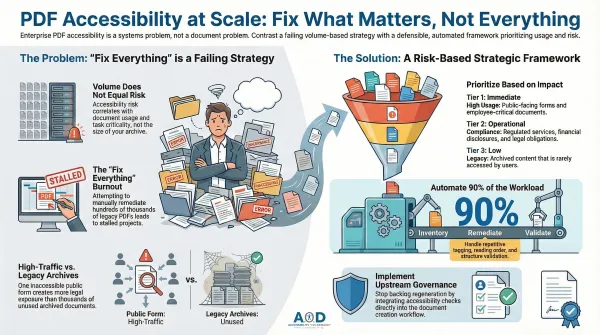
An enterprise may store hundreds of thousands of PDFs, many of which are legacy archives with little user activity. In contrast, a single inaccessible, high-traffic PDF form tied to an essential public or employee service can create immediate legal and reputational exposure.
Enforcement actions and settlement agreements consistently demonstrate that regulators evaluate whether an organization has implemented a defensible prioritization framework and whether it can show demonstrable progress. They do not require instantaneous remediation of every historical document. They evaluate reasonableness, maturity, and sustained effort.
Risk is driven by visibility, frequency, and the criticality of the task enabled by the document.
The Strategic Shift: From Volume Remediation to Governed Control
Defensible enterprise PDF accessibility requires answering three questions clearly:
Why were specific PDFs prioritized for remediation?
How are accessibility standards enforced for new documents?
How is compliance progress measured and sustained?
A risk-based PDF remediation strategy shifts organizations away from the unrealistic objective of fixing every file at once. Instead, it establishes a documented and automated system that reduces exposure over time while preventing backlog regeneration.
For CIOs, unmanaged PDF accessibility is not simply a compliance inconvenience. It represents an expanding liability surface across digital services, HR operations, financial disclosures, procurement workflows, and customer engagement platforms.
Addressing it requires governance architecture, not temporary remediation surges.
The Five Pillars of Scalable PDF Accessibility
Pillar 1: Risk-Based Categorization
Organizations typically manage hundreds of thousands of documents that fall into three tiers:
Tier 1: Immediate Risk
User Impact: Customer-facing, public-facing, or employee-critical documents that present immediate exposure
High Usage: A single inaccessible form tied to a critical service creates more legal exposure than thousands of unused archived documents
Tier 2: Operational Risk
Compliance Exposure: Documents required for regulatory, benefits, financial disclosures, or legal obligations
Tier 3: Low Risk
Legacy archives that exist but are rarely accessed
This tiered model replaces reactive remediation with defensible sequencing. Categorizing documents by exposure and business impact ensures that Section 508 PDF remediation and ADA PDF compliance efforts focus first on the content that creates measurable risk.
Pillar 2: Evidence-Driven Prioritization
An evidence-based approach transforms PDF remediation from a reactive backlog project into a strategic risk mitigation program.
CIOs use four key criteria to determine which documents move to the front of the remediation queue:
User Impact and Public Exposure: How many people need this document to access a service or perform a job? Documentation required for customer-facing or employee-critical tasks presents immediate risk because these documents are where assistive technology users are most likely to encounter barriers to effective communication.
Frequency and Longevity: Beyond simple access counts, usage is measured by how often a document is reused or distributed.
High-priority documents are those that are:
Repeatedly Distributed: PDFs that are sent out frequently to large groups
Templated Content: Documents based on templates that, if inaccessible, create compounding risk across every instance generated
Criticality of Task Completion: Documents that enable users to complete essential tasks (applying for benefits, submitting forms, accessing legal disclosures) carry higher risk than informational content.
Remediation Feasibility: Not all PDFs are equally remediable. Documents with complex layouts, scanned images without OCR, or legacy formats may require more manual intervention. Automation-first platforms help identify which documents can be remediated efficiently versus those requiring deeper review.
Pillar 3: Automation-First for Scalability
Manual PDF remediation does not scale to enterprise document volumes. Automated PDF accessibility platforms embedded into document authoring and publishing workflows enable organizations to:
Enforce WCAG-aligned standards at creation
Scan enterprise repositories for specific accessibility technical failures such as:
Missing form field labels
Broken reading orders
Improperly structured tables
Insufficient color contrast
Missing alternative text for images
Identify high-exposure documents
Identify inaccessible templates that can multiply risk across every instance generated
Remediate high-impact PDFs in volume
At enterprise scale, automated PDF accessibility is infrastructure, not a convenience.
Pillar 4: Upstream Governance to Prevent Backlog Regeneration
A framework is only defensible if it stops the regeneration of the backlog. CIO-led programs must integrate accessibility automation into document authoring and publishing workflows. By enforcing standards upstream, IT prevents non-compliant PDFs from being distributed in the first place, shifting the department's role from a remediation shop to a governed system.
This governance model ensures:
New documents are compliant at the point of creation
Templates and frequently reused content are accessible by default
Document management systems validate accessibility before publication
Content creators receive real-time feedback on accessibility conformance
Legal teams look for evidence that accessibility automation is integrated into document authoring and publishing workflows. By enforcing standards upstream, IT shifts from reactive remediation to a governed system, which is a key indicator of a legally defensible operating model.
Pillar 5: Audit-Ready Reporting and Measurable Progress
Executive and legal stakeholders require confidence that an enterprise accessibility program is sustainable. This is provided through reporting aligned with audit and legal requirements, which serves as the ultimate proof of a governed system.
The framework generates audit-ready reporting aligned with legal requirements, providing a clear record of the organization's remediation efforts and proving that new content is being created accessibly.
Required documentation includes:
Inventory Reports Comprehensive lists of PDFs across systems and repositories, identifying which have been remediated and which are in the queue.
WCAG and ADA Validation Reports Technical reports generated by automated platforms that consistently validate documents against specific success criteria to ensure functional usability.
Prioritization Documentation Clear evidence of why specific documents were prioritized, demonstrating the risk-based model in action.
Progress Tracking Metrics showing demonstrable progress over time, including remediation velocity, backlog reduction, and upstream prevention success rates.
This documentation turns PDF accessibility from a recurring crisis into a repeatable, data-driven operating model that can scale with the organization.
Practical Implementation Sequence
For CIOs evaluating or building a scalable PDF accessibility program, the following implementation sequence delivers the fastest time to defensibility:
Phase 1: Establish Visibility (Weeks 1-4)
Conduct a system-wide inventory of PDFs across all repositories
Categorize documents into Tier 1, 2, and 3 risk levels
Identify high-impact documents requiring immediate attention
Phase 2: Implement Automation (Weeks 5-12)
Deploy an automation-first platform to remediate Tier 1 documents
Integrate accessibility validation into document authoring workflows
Establish upstream governance controls to prevent backlog regeneration
Phase 3: Scale and Sustain (Ongoing)
Expand remediation to Tier 2 documents based on usage data
Generate audit-ready reporting for legal and compliance teams
Continuously refine prioritization based on emerging risk signals
Organizations that follow this sequence move from reactive remediation to proactive governance in a matter of months, not years.
The Strategic Outcome for CIOs: Confidence Through Governance
When PDF accessibility is governed through risk-based prioritization and automation, IT regains operational control. Accessibility risk becomes measurable. Compliance posture becomes defensible. The operating model scales alongside organizational growth.
Accessibility ceases to be a recurring crisis and becomes enterprise infrastructure.
The goal for CIOs is not to chase regulations. It is to build a scalable PDF accessibility system that reduces risk, supports users, and withstands audit scrutiny.
Next in the Series
Look for Week 5 in our 12-part "IT Accessibility Leadership" series: "Manual vs. Automated PDF Accessibility Remediation: Automation Is the Only Model That Scales."
About Accessibility on Demand™
Automation-first by design, not by compromise.
Accessibility on Demand™ (AoD™) is an enterprise-grade, automation-first PDF accessibility remediation platform. AoD™ aligns documents to WCAG and PDF/UA standards and supports compliance with Section 508, ADA Title II and III, and AODA requirements through a scalable, repeatable remediation framework.
The platform converts inaccessible PDFs into structured, audit-ready files in minutes, reducing dependency on manual services and significantly lowering total remediation costs. AoD™ provides organizations with measurable, consistent, and defensible accessibility outcomes suitable for regulatory scrutiny and internal audit review.
AoD™ Enterprise Capabilities:
Seamless integration with existing workflows and IDP stacks
High-volume batch processing for large files and document repositories
Third-party validation with WCAG and PDF/UA compliance scoring
Section 508 and ADA-aligned outputs with audit-ready reporting
Dedicated account management and enterprise support
Comprehensive onboarding and platform training
For Remediation Professionals:
AoD™ handles 90% of the heavy lifting (automated tagging, reading order, metadata, and structure) and delivers a complete tag tree, so accessibility specialists can still make subjective refinements and advanced remediation decisions where needed, rather than spending time on repetitive manual work.
Beat the Deadlines: Talk with a PDF Accessibility Specialist
The bar for IT accessibility in the public sector is rising. If your organization is navigating ADA compliance, WCAG requirements, or Section 508 accessibility and struggling to understand what applies to your PDF documents. Discover how AoD™ can ensure your organization stays ahead of accessibility deadlines, clarify scope, risk, and next steps.
External Links to Learn More About AoD:
To watch a 3-minute video about our AoD™ Solution, visit our Homepage: Accessibility On Demand (opens in new tab)
If you need help navigating ADA Title II regulations, please reach out to us to book a session:
Enterprise Contact Form (opens in new tab)
To Sign-up for a free trial of AoD, visit: Book a Demo (opens in new tab)
External Links to AoD’s "IT Leadership Blog" Series:
Week 1 - “Why PDF Accessibility Lands on IT's Desk" (opens in new tab)
A PEAK AHEAD:
Week 6 - "Decentralized PDFs: A Centralized Accessibility Crisis" (opens in a new tab)
Week 7 - "Third Party PDFs and Accessibility Compliance: Who Owns the Risk?" (opens in new tab)
External Links to Other Great AoD Blogs You Don't Want to Miss:
Blog: "The 2.5 Trillion PDF Problem" (opens in new tab)
Blog: "Breaking the PDF Barrier: How Your Agency Can Beat ADA Compliance Costs" (opens in new tab)
Blog: "Understanding ADA Title II Exceptions" (opens in new tab)
External Links to Additional Resources:
W3C: Web Content Accessibility Guidelines (WCAG) 2.1 (opens in new tab)
Section 508 Standards: https://www.section508.gov/ (opens in new tab)
ADA: Exceptions (opens in new tab)
First Steps Toward Compliance:https://www.ada.gov/resources/web-rule-first-steps/ (opens in new tab)
DOJ Title II Web Accessibility Final Rule: https://www.ada.gov/resources/2024-03-08-web-rule/ (opens in new tab)
