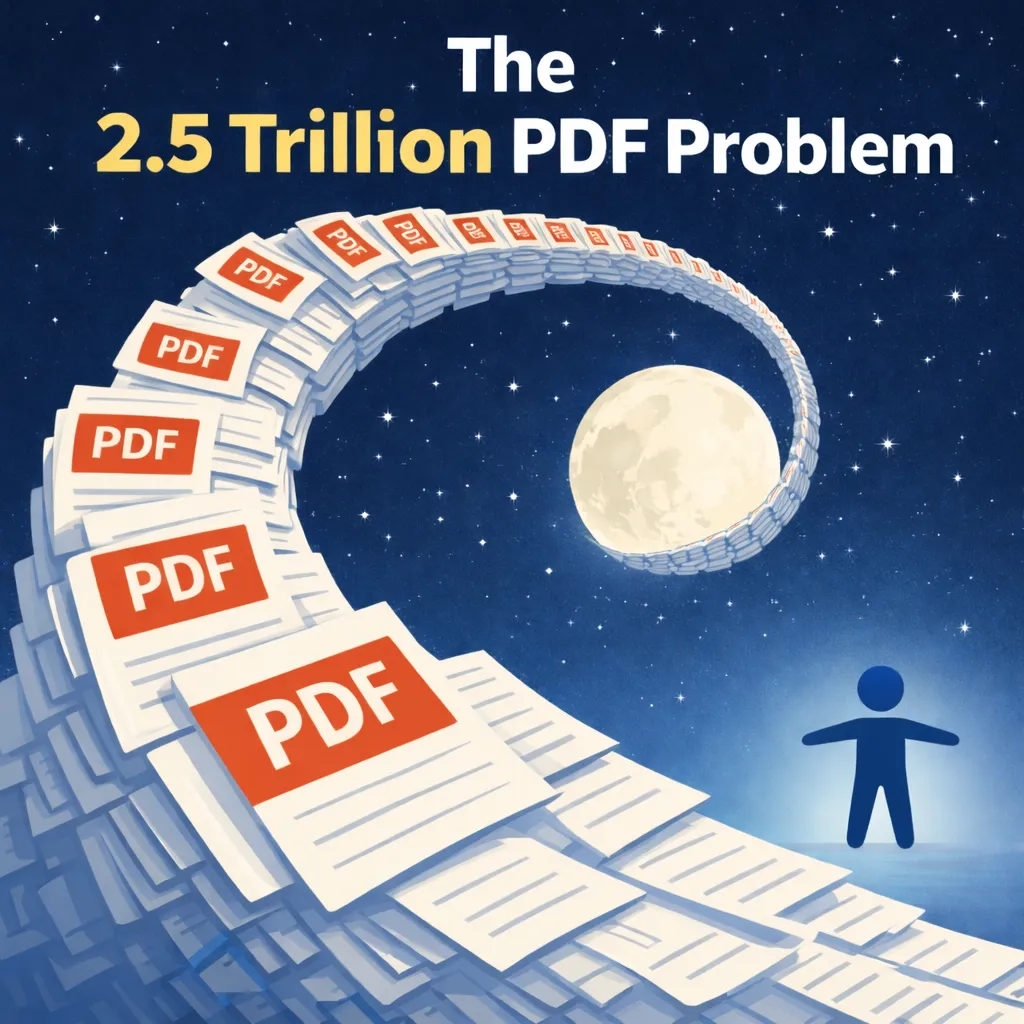
The 2.5 Trillion PDF Problem | AoD™
Right now, as you read this, 78 new PDFs enter the world. In the time it takes you to finish this article, another 23,400 will join them. Nearly all will be inaccessible to the 1.3 billion people worldwide who rely on assistive technology.
We've created the largest information barrier in human history, 2.5 trillion PDFs that screen readers can't read, that assistive technology can't navigate, that lock out anyone who can't see a traditional computer screen. Stack these documents and they'd reach the moon and back 325 times. The scale defies comprehension.
How We Built a Digital Prison
The story begins in 1993 when Adobe released the PDF format. Organizations rushed to digitize everything, believing they were modernizing. Instead, they were building walls.
They created:
Documents scanned as images, files that looked like text but registered as blank photographs to screen readers
Complex forms that keyboard users couldn't complete
Charts where color was the only differentiator.
Government agencies tasked with enforcing accessibility laws host documents that violate those very regulations. Universities distribute textbooks that blind students can't read. Hospitals share medication instructions as scanned images, rendering life-critical information invisible to those who need it most. Financial institutions lock economic participation behind inaccessible account statements and loan applications.
The math reveals the impossibility of our current approach. At 15 minutes per page for manual remediation, fixing existing PDFs would require 312 million full-time specialists working for an entire year. We have perhaps 50,000 accessibility professionals worldwide. Meanwhile, we create 6.8 million new inaccessible PDFs daily, adding to the backlog 1,700 times faster than we can fix it.
The Revolution That Changes Everything
Traditional remediation is like emptying an ocean with a teaspoon while fire hoses pump in more water. Even "automated" tools that achieve 35% efficiency still leave 65% of the work to human hands. We need something radically different.
True automation, 95% or higher, transforms the equation entirely. Artificial intelligence reads and understands context. Machine learning generates alternative text for images. Algorithms structure tables and determine reading order. Pattern recognition creates navigable forms. What took hours happens in seconds.
This isn't incremental improvement. It's revolution. Remediation becomes 1,000 times faster. Costs drop by 90-95%. Quality improves because machines don't tire, don't make subjective judgments, don't introduce human error. Organizations can finally achieve compliance at scale.
The Choice Before Us
We stand at a crossroads. Continue with traditional methods and by 2030 we'll have 5 trillion inaccessible PDFs. By 2035, 10 trillion. Compliance becomes mathematically impossible. The digital divide becomes permanent.
Or we embrace transformation. Deploy true automation. Eliminate the backlog. Ensure every new document is born accessible. By 2027, we could live in a world where PDF barriers no longer exist. Where information truly belongs to everyone.
The technology exists. Accessibility On Demand™ and similar platforms already achieve 95%+ automation. They process millions of pages in days, not decades. They guarantee high compliance scores. They make the impossible possible.
Your Role in Ending This Crisis
Every organization faces the same choice: remain part of the problem or become part of the solution. Every inaccessible PDF is a door slammed shut. Every automated remediation opens thousands of doors at once.
The 2.5 trillion PDF crisis isn't just a number. It's 1.3 billion people excluded from information that could change their lives. It's students who can't access education, patients who can't read medical instructions, citizens who can't participate fully in democracy.
We created this crisis through decades of oversight and outdated methods. We can end it through transformation and automated solutions. The question isn't whether you'll make your PDFs accessible. Regulations ensure that. The question is whether you'll do it in time to matter.
About Accessibility on Demand™
Automation-first by design, not by compromise. Delivering compliance, speed, and cost-savings in one solution.
Accessibility on Demand™ (AoD™) is an enterprise-grade, automation-first, AI-powered PDF remediation platform with third-party PAC-verified compliance scores. Built to streamline document accessibility at scale, AoD™ aligns files to WCAG and PDF/UA standards and supports compliance with Section 508, ADA Title II and III, and AODA requirements through a repeatable, audit-ready remediation workflow.
AoD™ transforms inaccessible PDFs into structured, accessible files in minutes, helping organizations reduce reliance on manual remediation services while lowering total remediation costs. The platform is designed to deliver consistent, measurable, and defensible accessibility outcomes that can stand up to regulatory scrutiny and internal audit review.
Enterprise Capabilities
Seamless integration with existing workflows and IDP stacks.
High-volume batch processing for large files and document repositories.
Third-party validation with WCAG and PDF/UA compliance scoring.
Section 508- and ADA-aligned outputs with audit-ready reporting.
Dedicated account management and enterprise support.
Comprehensive onboarding and platform training.
For Remediation Professionals
AoD™ handles over 95% of the heavy lifting, including automated tagging, reading order, contextual alt-text metadata, and document structure. It delivers a complete tag tree so accessibility specialists can focus on subjective refinements and advanced remediation decisions, rather than repetitive manual work.
Beat the Deadlines: Talk with a PDF Accessibility Specialist
The bar for IT accessibility in the public sector is rising. If your organization is navigating ADA compliance, WCAG requirements, or Section 508 accessibility and struggling to understand what applies to your PDF documents. Discover how AoD™ can ensure your organization stays ahead of accessibility deadlines, clarify scope, risk, and next steps.
If you need help navigating ADA Title II regulations, please reach out to us to book a session: Enterprise Contact Form (opens in new tab)
To Sign-up for a free trial of AoD, visit: Book a Demo (opens in new tab)
Learn More About AoD:
To watch a 3-minute video about our AoD™ Solution, visit our Homepage: Accessibility On Demand (opens in new tab)
AoD’s "IT Leadership Blog" Series:
Accessibility Insights (external link)
Week 1 - “Why PDF Accessibility Lands on IT's Desk"
Week 2 - “Why ‘Tagged PDF’ Does Not Mean WCAG Compliant: PDF Accessibility Requirements Explained"
Week 3 - “The Accessibility Triple Play: What PDF Accessibility Really Means for IT Leaders"
Week 4 - “Enterprise PDF Accessibility at Scale: A Governance Framework for CIOs"
Week 5 - "Manual vs. Automated PDF Accessibility Remediation: Automation Is the Only Model That Scales"
Week 6 - "Decentralized PDFs: A Centralized Accessibility Crisis"
Week 7 - "Third-Party PDFs and Accessibility Compliance: Who Owns the Risk?"
Week 8 - "When Forms Fail, Compliance Follows: The CIO's Hidden Accessibility Liability"
Week 9 - "Designing for Outcomes, Not Scores: The Future of PDF Accessibility Leadership"
Week 10 - “Stop Remediating PDFs. Build a Sustainable PDF Accessibility Program Instead."
Week 11 - "IT Is Not the Digital Accessibility Compliance Bottleneck. The DOJ Extension Gives CIOs Time to Prove It."
Week 12 - "Source Remediation vs. The HTML-Transcript Approach. Seven Dimensions That Determine Legal Exposure."
External Links to Other Great AoD Blogs You Don't Want to Miss:
Blog: "Breaking the PDF Barrier: How Your Agency Can Beat ADA Compliance Costs" (opens in new tab)
Blog: "Understanding ADA Title II Exceptions" (opens in new tab)
External Links to Additional Resources:
W3C: Web Content Accessibility Guidelines (WCAG) 2.1 (opens in new tab)
Section 508 Standards: https://www.section508.gov/ (opens in new tab)
ADA: Exceptions (opens in new tab)
First Steps Toward Compliance:https://www.ada.gov/resources/web-rule-first-steps/ (opens in new tab)
DOJ Title II Web Accessibility Final Rule: https://www.ada.gov/resources/2024-03-08-web-rule/ (opens in new tab)
