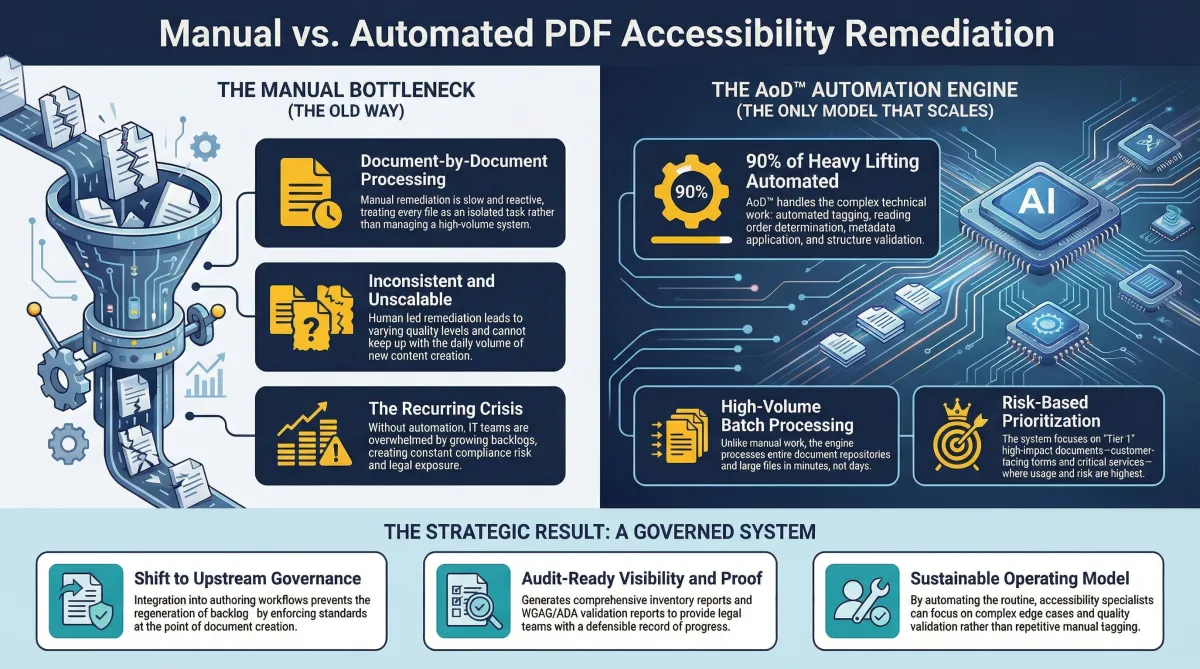
Manual vs. Automated PDF Accessibility Remediation: Automation Is the Only Model That Scales | AoD™
WEEK 5 | IT LEADERSHIP BLOG SERIES
For CIOs responsible for PDF accessibility compliance, operational risk, and enterprise scalability, accessibility is no longer a theoretical discussion. It is a systems challenge, defined by document volume, content velocity, and regulatory accountability.
At enterprise scale, the question is not whether manual PDF remediation works in isolated cases. The question is whether it works as an operating model.
It does not.
Practical starting point for CIOs:
Inventory where PDFs are created, stored, and published across the enterprise.
Identify which teams own those workflows today and how accessibility is currently being addressed, if at all.
When Manual PDF Remediation Hits the Wall
Manual PDF accessibility remediation depends on certified accessibility experts reviewing and fixing documents one at a time to meet WCAG, ADA, and Section 508 requirements. For small document sets, this approach can appear precise and controlled, and it often feels reassuring from a governance perspective.
As soon as organizations manage thousands or millions of PDFs, that perceived control begins to erode. Expert availability becomes the bottleneck. Turnaround times become unpredictable. Costs increase in direct proportion to document volume. Accessibility backlogs grow faster than teams can resolve them.
In practical terms, manual remediation often ranges from roughly 15 to 40 US dollars per page depending on complexity, document quality, and vendor or internal labor rates. A backlog of 50,000 documents can quickly translate into hundreds of thousands, or even millions, of dollars over several years if the organization relies solely on manual work.
Most critically, PDF accessibility compliance becomes dependent on human throughput, not system capability. For CIOs, that represents structural risk to the organization, both in terms of regulatory exposure and in the ability to support a sustainable digital accessibility strategy.
Practical steps to assess manual remediation risk:
Quantify current backlog: number of PDFs, age, and risk profile (public facing, high use, regulatory relevance).
Map current remediation workflow from request intake to delivery and identify every human dependency.
Track cycle time and cost per document for a representative sample over 30–60 days.
PDF Accessibility: Craftsmanship or Capacity Problem?
PDF accessibility is often framed as a craftsmanship exercise that focuses on perfecting individual documents. At enterprise scale, this framing breaks down. Accessibility at scale is not primarily an artisan problem. It is a throughput and reliability problem.
Organizations continuously generate PDFs across departments, platforms, and external vendors. Contracts, statements, reports, forms, notices, and marketing collateral all enter the ecosystem in PDF format. Remediating documents one by one, regardless of how skilled the expert, cannot keep pace with content creation velocity.
This is why accessibility initiatives stall, why internal audits surface recurring gaps, and why external reviews often reveal inconsistent compliance. The core issue is not intent or expertise. The root issue is scale and the lack of a systemic, automation-first approach to PDF accessibility.
Practical steps to reframe PDF accessibility as a scale problem:
Calculate monthly and annual PDF creation volume across core systems (ERP, CRM, HR, finance, web CMS).
Classify PDFs by risk and impact tiers, such as “high exposure” (public, required notices), “medium” (frequent use), and “low” (internal archival).
Compare creation volume with current remediation throughput to make the scale gap visible to stakeholders.
Why Automation-First PDF Accessibility Is a Strategic Imperative
For organizations serious about ADA, WCAG, and Section 508 compliance, automation-first PDF accessibility is no longer a nice-to-have innovation. It is a necessary operating model.
An automation-first PDF accessibility model enables remediation at a speed, volume, and consistency that manual processes cannot achieve. Through advanced OCR, intelligent document capture, AI-driven tagging, structural remediation, and machine-validated compliance checks, accessibility is engineered into the remediation pipeline instead of bolted on at the end.
From a cost perspective, automation-first models fundamentally change the economics of PDF accessibility at scale. Effective per-page costs decrease as volume, standardization, and governance maturity increase, with pricing calibrated to the level of remediation and expert oversight required. By combining template-driven automation, intelligent batching, and targeted exception handling, organizations move away from unpredictable, file-by-file labor spend toward a structured, platform-based operating model that improves cost control, scalability, and audit defensibility.
This shift transforms PDF accessibility from a labor-intensive task into a governed, repeatable system. It allows CIOs and digital accessibility leaders to treat PDF remediation like other core IT capabilities, with defined workflows, measurable outputs, and clear accountability.
Practical steps to evaluate automation-first solutions:
Define technical requirements: volume targets, file types, language support, integration points, and reporting needs.
Pilot automated remediation on a diverse set of PDFs that reflect real-world complexity (forms, tables, scanned documents).
Compare automated outputs against internal standards using both automated checkers and expert review to validate quality.
What an Automation-First Model Delivers for CIOs
An automation-first approach delivers outcomes that CIOs already prioritize in other domains such as cybersecurity, observability, and compliance automation. In the context of PDF accessibility, these outcomes include:
Predictable PDF remediation timelines, aligned with SLAs and audit requirements.
Consistent WCAG and ADA compliance across large document sets, regardless of origin.
Significantly lower cost per document at scale, with clearer budgeting and forecasting.
Centralized visibility into enterprise-wide PDF accessibility posture.
The ability to remediate existing backlogs while controlling the flow of new content.
Most importantly, automation-first PDF accessibility shifts organizations from reactive remediation to proactive accessibility risk management. Instead of scrambling to fix documents when an audit or complaint arises, CIOs can operate from a position of readiness, supported by a remediation pipeline that is built to scale.
Practical steps to operationalize automated remediation:
Establish SLAs for different PDF risk tiers and configure workflows to meet those targets.
Integrate remediation into existing content pipelines, such as ECM systems and records management platforms.
Build dashboards that track remediation throughput, error rates, and compliance posture by department or content source.
Where Human Expertise Belongs in an Automated World
Automation does not remove the need for certified accessibility experts. It fundamentally redefines how and where their expertise is applied.
In an automation-first operating model, experts no longer spend most of their time performing repetitive, document-by-document remediation tasks. Instead, they focus on validation, governance, exception handling, policy alignment, and ongoing compliance oversight. Automation can perform a large percentage of remediation steps at-scale, while experts apply judgment where nuance, risk, and user experience matter most.
This is not simply a hybrid remediation model that bolsters manual work with tools. It is an automation-first system with expert control points. Certified professionals guide the rules, review exceptions, and ensure that automated PDF accessibility aligns with both regulatory standards and the organization’s inclusion goals.
Practical steps to redefine expert roles:
Create clear roles such as “Accessibility Governance Lead,” “Remediation Quality Reviewer,” and “Exception Handling Specialist.”
Document escalation paths for complex or high-risk documents that require human review.
Provide experts with analytics from the automated system so they can refine rules and focus on the highest-value interventions.
The Real Cost of Staying Manual
Manual PDF remediation is often defended as more accurate or more defensible. In practice, it becomes slower, more expensive, and harder to govern as document volume and complexity increase. When every file depends on human labor, total cost of ownership grows directly with content volume and with the number of audits and change requests.
Automation-first PDF accessibility is not about cutting corners. It is about aligning accessibility compliance with how modern IT systems operate and scale. CIOs have already seen this pattern in cybersecurity, infrastructure management, cloud orchestration, monitoring, and policy automation. Digital accessibility follows the same trajectory.
As cost escalates, it is important to recognize that the financial pressure is a symptom of a model that does not scale. The real decision point is architectural. The question is whether accessibility processes are designed to function at the volume and velocity of enterprise content.
Practical steps to build a business case:
Model total cost of ownership for manual remediation over three to five years, including internal labor, vendor contracts, and audit response.
Compare that model to an automation-first approach that blends platform licensing, infrastructure, and targeted expert oversight.
Include risk reduction and avoided costs from potential complaints, consent decrees, and delayed projects in your justification.
The CIO Fork in the Road
For CIOs, the decision is not between quality and automation. It is between processes that break under scale and systems that are designed to handle it.
Manual remediation may resolve individual PDFs. Automated PDF accessibility remediation resolves organizational risk. Manual approaches can demonstrate good intentions on a small sample of documents. Automation-first models demonstrate operational maturity across the entire portfolio.
This distinction matters when regulators, auditors, and the public evaluate whether an organization has taken digital accessibility seriously. An automation-first PDF accessibility strategy sends a clear signal that accessibility is treated as a core enterprise capability, not an ad hoc project.
Practical decision checklist for CIOs:
Can our current model handle a sudden spike in document volume triggered by a policy or regulatory change?
Do we have consistent visibility into the accessibility status of our PDF inventory?
If audited today, could we demonstrate a repeatable, scalable process, not just isolated success stories?
Strategic Takeaway: Turn Accessibility into an Enterprise Capability
PDF accessibility is no longer a document-level challenge. It is an enterprise systems problem that belongs in the same strategic conversation as security, data governance, and compliance automation.
CIOs who adopt automation-first PDF accessibility remediation stop chasing backlogs and start managing compliance as an operational capability. They gain better visibility, better predictability, and a stronger foundation for digital inclusion.
At scale, automation is not optional. It is the only model that works for sustainable, enterprise-grade PDF accessibility compliance.
Next steps to move from concept to action:
Identify a high-impact, high-visibility document set to serve as a pilot for automation-first remediation.
Partner with your accessibility and compliance leaders to define success metrics in advance.
Use the pilot results to inform a roadmap that includes technology selection, process redesign, and role definition.
Next in the Series
Look for Week 6 in our 12-part "IT Accessibility Leadership" series: “Decentralized PDFs: A Centralized Accessibility Crisis”. By routing PDFs from every department and vendor through an automation-first accessibility pipeline, CIOs gain a centralized, auditable way to achieve WCAG, ADA, and Section 508 PDF accessibility at scale without slowing down the business
About Accessibility on Demand™
Automation-first by design, not by compromise. Delivering compliance, speed, and cost-savings in one solution.
Accessibility on Demand™ (AoD™) is an enterprise-grade, automation-first, AI-powered PDF remediation platform with third-party PAC-verified compliance scores. Built to streamline document accessibility at scale, AoD™ aligns files to WCAG and PDF/UA standards and supports compliance with Section 508, ADA Title II and III, and AODA requirements through a repeatable, audit-ready remediation workflow.
AoD™ transforms inaccessible PDFs into structured, accessible files in minutes, helping organizations reduce reliance on manual remediation services while lowering total remediation costs. The platform is designed to deliver consistent, measurable, and defensible accessibility outcomes that can stand up to regulatory scrutiny and internal audit review.
Enterprise Capabilities
Seamless integration with existing workflows and IDP stacks.
High-volume batch processing for large files and document repositories.
Third-party validation with WCAG and PDF/UA compliance scoring.
Section 508- and ADA-aligned outputs with audit-ready reporting.
Dedicated account management and enterprise support.
Comprehensive onboarding and platform training.
For Remediation Professionals
AoD™ handles over 95% of the heavy lifting, including automated tagging, reading order, contextual alt-text metadata, and document structure. It delivers a complete tag tree so accessibility specialists can focus on subjective refinements and advanced remediation decisions, rather than repetitive manual work.
Beat the Deadlines: Talk with a PDF Accessibility Specialist
The bar for IT accessibility in the public sector is rising. If your organization is navigating ADA compliance, WCAG requirements, or Section 508 accessibility and struggling to understand what applies to your PDF documents. Discover how AoD™ can ensure your organization stays ahead of accessibility deadlines, clarify scope, risk, and next steps.
If you need help navigating ADA Title II regulations, please reach out to us to book a session: Enterprise Contact Form (opens in new tab)
To Sign-up for a free trial of AoD, visit: Book a Demo (opens in new tab)
Learn More About AoD:
To watch a 3-minute video about our AoD™ Solution, visit our Homepage: Accessibility On Demand (opens in new tab)
AoD’s "IT Leadership Blog" Series:
Accessibility Insights (external link)
Week 1 - “Why PDF Accessibility Lands on IT's Desk"
Week 2 - “Why ‘Tagged PDF’ Does Not Mean WCAG Compliant: PDF Accessibility Requirements Explained"
Week 3 - “The Accessibility Triple Play: What PDF Accessibility Really Means for IT Leaders"
Week 4 - “Enterprise PDF Accessibility at Scale: A Governance Framework for CIOs"
Week 5 - "Manual vs. Automated PDF Accessibility Remediation: Automation Is the Only Model That Scales"
Week 6 - "Decentralized PDFs: A Centralized Accessibility Crisis"
Week 7 - "Third-Party PDFs and Accessibility Compliance: Who Owns the Risk?"
Week 8 - "When Forms Fail, Compliance Follows: The CIO's Hidden Accessibility Liability"
Week 9 - "Designing for Outcomes, Not Scores: The Future of PDF Accessibility Leadership"
Week 10 - “Stop Remediating PDFs. Build a Sustainable PDF Accessibility Program Instead."
Week 11 - "IT Is Not the Digital Accessibility Compliance Bottleneck. The DOJ Extension Gives CIOs Time to Prove It."
Week 12 - "Source Remediation vs. The HTML-Transcript Approach. Seven Dimensions That Determine Legal Exposure."
External Links to Other Great AoD Blogs You Don't Want to Miss:
Blog: "The 2.5 Trillion PDF Problem" (opens in new tab)
Blog: "Breaking the PDF Barrier: How Your Agency Can Beat ADA Compliance Costs" (opens in new tab)
Blog: "Understanding ADA Title II Exceptions" (opens in new tab)
External Links to Additional Resources:
W3C: Web Content Accessibility Guidelines (WCAG) 2.1 (opens in new tab)
Section 508 Standards: https://www.section508.gov/ (opens in new tab)
ADA: Exceptions (opens in new tab)
First Steps Toward Compliance:https://www.ada.gov/resources/web-rule-first-steps/ (opens in new tab)
DOJ Title II Web Accessibility Final Rule: https://www.ada.gov/resources/2024-03-08-web-rule/ (opens in new tab)
