Understanding ADA Title II Exceptions | AoD™
Executive Summary
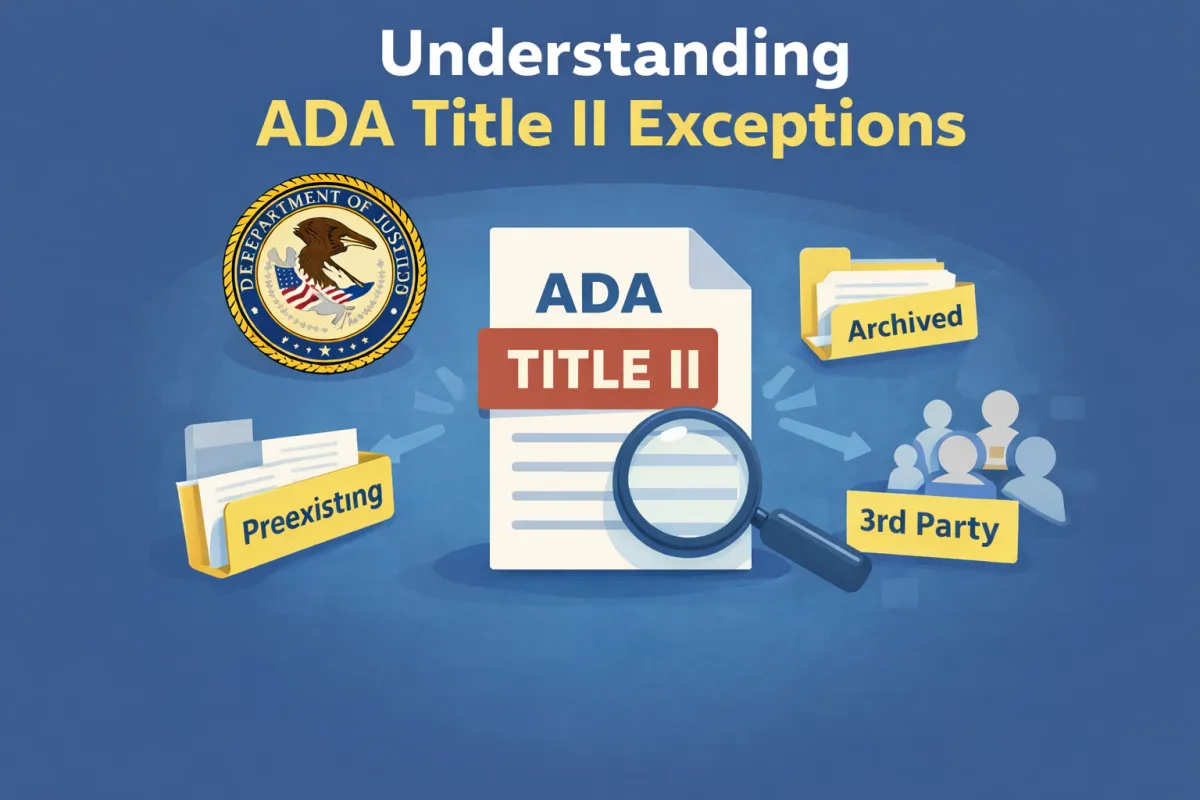
The Department of Justice finalized a rule in April 2024 requiring all state and local government web content and mobile applications to meet WCAG 2.1 Level AA accessibility standards by April 2026 (for entities serving 50,000+ people) or April 2027 (for smaller entities). While the regulation includes specific exceptions for archived content, certain pre-existing documents, and third-party content, these exceptions are far narrower than most organizations assume. The goal is not to find reasons to avoid making content accessible, but to find the most efficient path to full accessibility. This document clarifies what actually qualifies as an exception under Title II, dispels common misconceptions, and provides a framework for prioritizing remediation efforts.
What ADA Title II Requires
The Americans with Disabilities Act (ADA) Title II applies to all state and local government entities, mandating that their services, programs, and activities be accessible to individuals with disabilities. The DOJ's April 2024 final rule establishes WCAG 2.1 Level AA as the mandatory technical standard for all web content and mobile applications provided by these public entities.
Key Requirements:
Scope: All web content and mobile apps, including:
websites
online portals
intranets
employee systems
and electronic documents (PDFs, Word files, spreadsheets) made available online
Standard: Web Content Accessibility Guidelines (WCAG) 2.1 Level AA conformance (Link)
Compliance Deadlines:
Public entities serving 50,000 or more people: April 24, 2026
Public entities serving fewer than 50,000 people and special district governments: April 26, 2027
Coverage: Both public-facing and internal content that constitutes part of the entity's services, programs, or activities
The WCAG 2.1 Level AA standard includes requirements for proper document structure (headings, lists, tables), alternative text for images, keyboard accessibility, color contrast, captions for videos, and proper form field labels. For PDFs specifically, this means documents must be properly tagged, have a logical reading order, include alt text for images, and be compatible with assistive technologies like screen readers.
Official Exceptions Under Title II
The DOJ's final rule includes three narrow, specific exceptions. Understanding these exceptions requires careful attention to the qualifying criteria.
1. Archived Web Content Exception
Definition: Content that was created before the compliance deadline and is retained exclusively for historical reference may be exempt from WCAG 2.1 AA requirements.
All Four Criteria Must Be Met:
The content was created before the applicable compliance date (April 24, 2026, or April 26, 2027)
The content is kept exclusively for reference, research, or recordkeeping purposes
The content is not altered or updated after being archived
The content is stored in a clearly identified, dedicated archived area of the website
What Qualifies:
A digitized collection of historical meeting minutes from 1995 stored in a section labeled "Historical Archives"
A 1998 water quality report in a dedicated "Archive" section that is no longer linked from current pages
Annual reports from previous decades maintained solely for historical recordkeeping
What Does NOT Qualify:
Any document currently used to apply for, access, or participate in government services (e.g., permit applications, tax forms, program enrollment forms)
Content that is regularly accessed by the public for current information
Documents that have been updated or modified after the compliance date
Old content that is not in a clearly designated archive area
2. Preexisting Conventional Electronic Documents Exception
Definition: Word processing files, PDFs, spreadsheets, and presentation files that were posted on the website before the compliance date may be exempt.
Critical Limitation: This exception does NOT apply if the document is currently used to apply for, gain access to, or participate in the public entity's services, programs, or activities.
3. Third-Party Content Exception
Definition: Content posted by a third party who is not acting on behalf of or under contract with the public entity may be exempt.
What Does NOT Qualify:
Content created by vendors, contractors, or consultants working under agreement with the public entity
Third-party platforms used to deliver government services (e.g., online payment portals, scheduling systems)
Content developed by outside technology companies for the government's use
4. Fundamental Alteration and Undue Burden Defenses
These are legal defenses, not automatic exceptions. They may be invoked only under strict procedural requirements:
The decision must be made by the head of the public entity or their designee
The decision must be based on consideration of all available resources (not just a single department's budget)
The decision must be documented in a formal written statement explaining the reasons
Even when the defense is validly asserted, the entity must still provide an alternative means of access.
Common Misconceptions: What People Think vs. What the Law Says
All old content is automatically exempt because it's archived.
Only content meeting all four strict criteria for the archived content exception is exempt. Most legacy content that is still publicly accessible does NOT qualify.
We can claim everything is an undue burden because we have a small budget.
The undue burden defense requires a formal written determination by the agency head considering ALL resources, not just one department's budget.
Content created by our vendors and contractors is third-party content, so it's exempt.
Third-party content posted by contractors or vendors working for the government is NOT exempt. The exception only applies to content posted by members of the public.
Section 508 compliance is enough for state and local governments.
Section 508 requires WCAG 2.0 Level AA. ADA Title II now requires the higher standard of WCAG 2.1 Level AA.
Internal documents and employee intranets don't need to be accessible.
All web content that is part of the entity's services, programs, or activities must be accessible, including internal systems.
"We've always done it this way" is a valid reason not to remediate.
Legacy practices are not an exception. The law requires accessibility regardless of how long a process has been in use.
Recommended Approach to Compliance
Prioritization Framework
Tier 1: Critical, High-Impact Content (Immediate Priority)
Online forms and applications for government services
Payment portals and transaction systems
Emergency alerts and public safety information
High-traffic pages and frequently accessed services
Tier 2: Important Public-Facing Content
Program information and eligibility requirements
Educational resources and guides
Meeting agendas, minutes, and public notices
Maps and facility information
Tier 3: General Content and Lower-Traffic Pages
Historical reports and reference materials
Supplementary information and background documents
Less frequently accessed pages
Tier 4: Truly Exempt Content
Content meeting all four criteria for the archived content exception
Preexisting documents not currently used to access services
Genuine third-party user-generated content
"When in Doubt, Remediate" Philosophy
If there is any uncertainty about whether content qualifies for an exception, remediate it
If a document might be needed by the public to access a service, make it accessible
If content is linked from a current page or appears in search results, treat it as active content requiring remediation
Mission-Focused Framing
Accessibility compliance is not a legal checkbox exercise. Its goal is to ensure that all members of the community, including the approximately 26% of U.S. adults who live with a disability, can fully participate in civic life.
As a leading State Accessibility Officer recently stated: "All the things they say are exceptions, we should be doing anyway."
Key Message:
Organizations assume most of their content that qualifies as an exception should still be considered for remediation to ensure commitment to full accessibility and equal access to government services. AoD™ makes comprehensive remediation economically feasible at scale, allowing organizations to adopt a "just do it all" approach rather than spending time and resources trying to parse narrow exception criteria, only to be called out later for non-compliance.
About Accessibility on Demand™
Automation-first by design, not by compromise. Delivering compliance, speed, and cost-savings in one solution.
Accessibility on Demand™ (AoD™) is an enterprise-grade, automation-first, AI-powered PDF remediation platform with third-party PAC-verified compliance scores. Built to streamline document accessibility at scale, AoD™ aligns files to WCAG and PDF/UA standards and supports compliance with Section 508, ADA Title II and III, and AODA requirements through a repeatable, audit-ready remediation workflow.
AoD™ transforms inaccessible PDFs into structured, accessible files in minutes, helping organizations reduce reliance on manual remediation services while lowering total remediation costs. The platform is designed to deliver consistent, measurable, and defensible accessibility outcomes that can stand up to regulatory scrutiny and internal audit review.
Enterprise Capabilities
Seamless integration with existing workflows and IDP stacks.
High-volume batch processing for large files and document repositories.
Third-party validation with WCAG and PDF/UA compliance scoring.
Section 508- and ADA-aligned outputs with audit-ready reporting.
Dedicated account management and enterprise support.
Comprehensive onboarding and platform training.
For Remediation Professionals
AoD™ handles over 95% of the heavy lifting, including automated tagging, reading order, contextual alt-text metadata, and document structure. It delivers a complete tag tree so accessibility specialists can focus on subjective refinements and advanced remediation decisions, rather than repetitive manual work.
Beat the Deadlines: Talk with a PDF Accessibility Specialist
The bar for IT accessibility in the public sector is rising. If your organization is navigating ADA compliance, WCAG requirements, or Section 508 accessibility and struggling to understand what applies to your PDF documents. Discover how AoD™ can ensure your organization stays ahead of accessibility deadlines, clarify scope, risk, and next steps.
If you need help navigating ADA Title II regulations, please reach out to us to book a session: Enterprise Contact Form (opens in new tab)
To Sign-up for a free trial of AoD, visit: Book a Demo (opens in new tab)
Learn More About AoD:
To watch a 3-minute video about our AoD™ Solution, visit our Homepage: Accessibility On Demand (opens in new tab)
AoD’s "IT Leadership Blog" Series:
Accessibility Insights (external link)
Week 1 - “Why PDF Accessibility Lands on IT's Desk"
Week 2 - “Why ‘Tagged PDF’ Does Not Mean WCAG Compliant: PDF Accessibility Requirements Explained"
Week 3 - “The Accessibility Triple Play: What PDF Accessibility Really Means for IT Leaders"
Week 4 - “Enterprise PDF Accessibility at Scale: A Governance Framework for CIOs"
Week 5 - "Manual vs. Automated PDF Accessibility Remediation: Automation Is the Only Model That Scales"
Week 6 - "Decentralized PDFs: A Centralized Accessibility Crisis"
Week 7 - "Third-Party PDFs and Accessibility Compliance: Who Owns the Risk?"
Week 8 - "When Forms Fail, Compliance Follows: The CIO's Hidden Accessibility Liability"
Week 9 - "Designing for Outcomes, Not Scores: The Future of PDF Accessibility Leadership"
Week 10 - “Stop Remediating PDFs. Build a Sustainable PDF Accessibility Program Instead."
Week 11 - "IT Is Not the Digital Accessibility Compliance Bottleneck. The DOJ Extension Gives CIOs Time to Prove It."
Week 12 - "Source Remediation vs. The HTML-Transcript Approach. Seven Dimensions That Determine Legal Exposure."
External Links to Other Great AoD Blogs You Don't Want to Miss:
Blog: "The 2.5 Trillion PDF Problem" (opens in new tab)
Blog: "Breaking the PDF Barrier: How Your Agency Can Beat ADA Compliance Costs" (opens in new tab)
External Links to Additional Resources:
W3C: Web Content Accessibility Guidelines (WCAG) 2.1 (opens in new tab)
Section 508 Standards: https://www.section508.gov/ (opens in new tab)
ADA: Exceptions (opens in new tab)
First Steps Toward Compliance:https://www.ada.gov/resources/web-rule-first-steps/ (opens in new tab)
DOJ Title II Web Accessibility Final Rule: https://www.ada.gov/resources/2024-03-08-web-rule/ (opens in new tab)