IT Is Not the Digital Accessibility Compliance Bottleneck. The DOJ Extension Gives CIOs Time to Prove It. | AoD™
WEEK 11 | IT LEADERSHIP SERIES
The DOJ moved the deadline
That decision deserves attention, not just for the compliance calendar it changes but for what it says about the problem itself.
When digital accessibility falls behind, IT takes the blame. The real problem is manual processes and tools never designed for enterprise scale.
In April 2026, the DOJ extended its ADA Title II compliance deadline to April 26, 2027, giving organizations the runway to fix the right thing.
In April 2026, the Department of Justice issued an interim final rule extending its ADA Title II digital accessibility compliance deadline by one year. Public entities with populations of 50,000 or more now have until April 26, 2027. Smaller entities and special districts have until April 26, 2028. The DOJ stated it had overestimated the staffing and technology capacity of covered entities to comply in the original timeframe.
That is a significant admission. The original timeline was not long enough to do what IT digital accessibility compliance truly requires. It was long enough to buy scanner tools and hire remediation vendors. It was not long enough to re-architect content production across an enterprise, integrate accessibility into application layers, rewrite procurement standards for new software, or train the authoring population that creates content every day.
Those are the changes that fix the problem at the root. They take more time than a tight deadline allows.
The 12-Week IT Leadership Series has been building toward exactly this argument from the start: the organizations that succeed at compliance are the ones that build accessibility into their systems, not the ones that sprint to clean it up before a deadline. The DOJ extension is, in effect, a hall-pass to do that work correctly. The question is whether each organization uses the time that way.
Why IT Keeps Getting Blamed for IT Digital Accessibility Compliance Failures
When accessibility backlogs grow and remediation costs climb, IT is usually first in line. The team is too slow. The queue is too long. The backlog never shrinks. From the outside, it looks like a capacity problem; however, it is a proven systems problem.
IT teams are not failing at digital accessibility compliance. They are being asked to do industrial-scale work with tools designed for individual documents. Every new PDF published without accessibility controls adds to the queue IT is expected to clear. That queue has no ceiling because nothing in the production process was designed to stop it.
Blaming IT for this outcome is the equivalent of asking one person to manually review every outgoing email and then questioning why responses are delayed. The constraint is not the person. It is the structure of the work.
The moment the framing shifts from "IT is the problem" to "the model is the problem," the path forward becomes clear. The DOJ extension, for organizations willing to use it correctly, is the window to make that shift.
IT Digital Accessibility Compliance Is a Systems Challenge, Not a Document Problem
Here is what most organizations miss when they look at accessibility backlogs. An inaccessible PDF did not become inaccessible when someone clicked Export. It became inaccessible the moment it was authored in a tool with no concept of document structure, alt text, or tagging. An inaccessible website is not a website problem. It is a CMS producing inaccessible pages at-scale. An inaccessible form is usually not a form problem at all. It is an ERP configuration issue, a Salesforce community template issue, a SharePoint pipeline issue. The symptom shows up in the document. The source lives upstream.
Accessibility is a property of systems. Treating it as a property of individual documents is why the backlog never ends.
The organizations that have solved digital accessibility compliance at scale did not remediate their way out of the problem. They redesigned the systems that create the problem. PDF accessibility is not fundamentally different from other infrastructure challenges IT has led before. Data governance required moving quality controls upstream into the systems that generate data. Cybersecurity required shifting from reactive patching to proactive architecture. Accessibility requires the same structural response: embed controls at the point of creation, automate the repeatable work, and govern the process rather than the individual document.
That is squarely within IT's mandate. Infrastructure is where IT leads.
What the DOJ Extension Makes Possible for CIOs
The organizations that would have wasted the original deadline will waste this extension too. That is the honest version of this.
But for the organizations that want to build something durable, the extra year changes what is possible. A CIO can work accessibility requirements into the next procurement cycle instead of bolting them onto contracts already signed. An IT team can get into conversation with application owners across ERP, CRM, and document management platforms, identify where inaccessible content is being produced, and fix it at the source instead of downstream.
A year is not a lot of extra time. But it is enough to change what gets built.
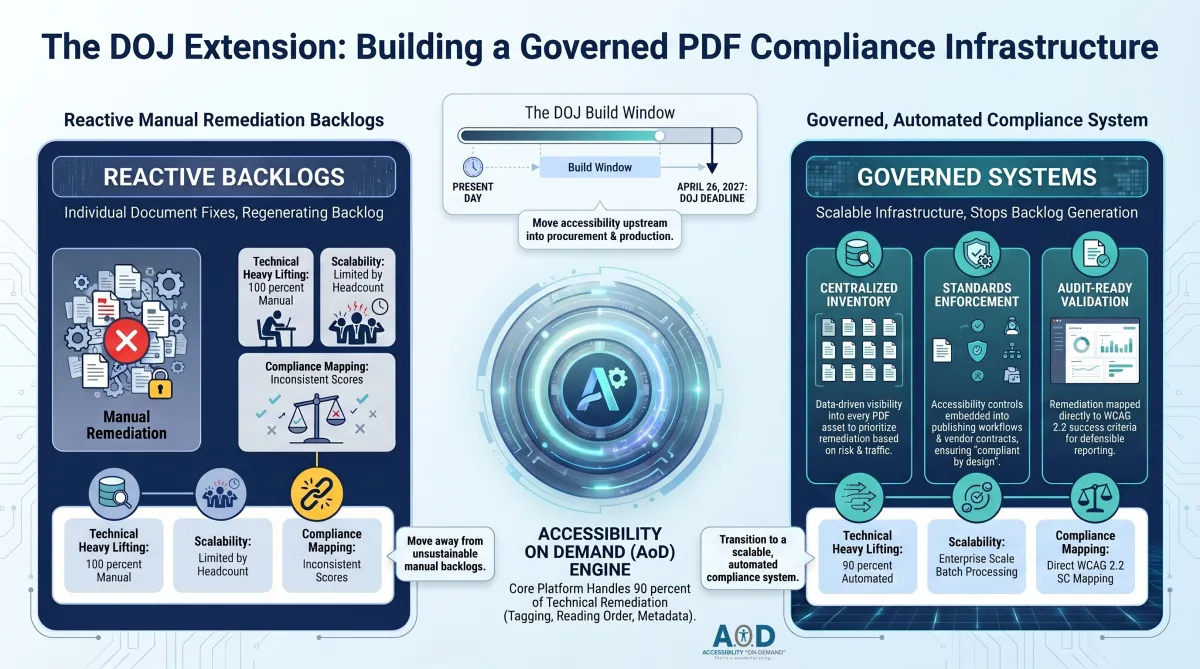
The DOJ cited that it extended the deadline specifically to allow for efficient preparation and full compliance with the 2024 final rule. That is a regulator giving organizations room to do this correctly. Organizations that treat the extension as breathing room to slow down will arrive at April 2027 in the same position they are in today. Organizations that treat it as a build window will arrive with a governed, automated program that does not depend on deadline pressure to function.
What Changes When IT Has the Right PDF Accessibility Tooling
An automation-first PDF accessibility platform does not remove IT from the compliance process. It changes what IT is doing. Instead of processing document-level remediation requests, IT manages the infrastructure that handles remediation at scale.
Centralized inventory. IT gains visibility into every PDF across the organization, including which documents carry the greatest compliance risk, which are high-traffic, and which have never been reviewed. Prioritization becomes data-driven rather than complaint-driven.
Automated remediation. Large document batches are processed consistently, applying document structure, reading order, alt text, and tagging logic without manual intervention at each step. Volume becomes manageable without proportional increases in headcount or cost.
Standards enforcement. Accessibility requirements are embedded into publishing workflows and vendor contracts so new documents arrive in a compliant state. The backlog stops regenerating.
Audit-ready validation. Compliance scoring maps to specific WCAG 2.2 success criteria: SC 1.3.1 (Info and Relationships), SC 1.1.1 (Non-text Content), SC 2.4.6 (Headings and Labels), and SC 4.1.2 (Name, Role, Value) for interactive form fields. Reporting is structured for external auditors, not just internal dashboards.
Usability assurance. A document that passes automated checks but fails a screen reader user is not compliant in any meaningful sense. The right platform validates that remediated documents are genuinely usable with assistive technology, not just technically tagged.
Moving IT From Remediation Queue to Governed IT Digital Accessibility Compliance
The bottleneck framing is not new. Neither is the solution. CIOs have navigated the same transition in security, infrastructure management, and data governance. In each case, the path was the same: replace manual processes with platforms, replace guesswork with visibility, replace reactive response with governed automation.
Digital accessibility is on that same arc. The organizations that reached sustainable compliance did not get there by working harder on remediation. They got there by making manual remediation unnecessary for the majority of their document volume.
IT is not behind on digital accessibility compliance. In most organizations, IT has not yet been given the tools that match the scale of the problem. When those tools are in place, the bottleneck narrative dissolves on its own.
The April 2027 deadline will arrive either way. The difference is whether organizations arrive there with a governed, automated compliance program or a pile of remediation receipts and an open backlog.
Get IT in the room. Look upstream. Fix the production system, not just its output. The deadline is the same for everyone. What each organization builds between now and then is not.
Next in the Series
Look for the final week in our 12-part IT Leadership Blog series: "Stop Remediating. Start Automating. The CIO's Case for PDF Accessibility Automation at Enterprise Scale.”
About Accessibility on Demand™
Automation-first by design, not by compromise.
Accessibility on Demand™ (AoD™) is an enterprise-grade, automation-first PDF accessibility remediation platform. AoD™ aligns documents to WCAG and PDF/UA standards and supports compliance with Section 508, ADA Title II and III, and AODA requirements through a scalable, repeatable remediation framework.
The platform converts inaccessible PDFs into structured, audit-ready files in minutes, reducing dependency on manual services and significantly lowering total remediation costs. AoD™ provides organizations with measurable, consistent, and defensible accessibility outcomes suitable for regulatory scrutiny and internal audit review.
AoD™ Enterprise Capabilities:
Seamless integration with existing workflows and IDP stacks
High-volume batch processing for large files and document repositories
Third-party validation with WCAG and PDF/UA compliance scoring
Section 508 and ADA-aligned outputs with audit-ready reporting
Dedicated account management and enterprise support
Comprehensive onboarding and platform training
For Remediation Professionals:
AoD™ handles over 95% of the heavy lifting (automated tagging, reading order, contextual alt-text metadata, and structure) and delivers a complete tag tree, so accessibility specialists can still make subjective refinements and advanced remediation decisions where needed, rather than spending time on repetitive manual work.
Beat the Deadlines: Talk with a PDF Accessibility Specialist
The bar for IT accessibility in the public sector is rising. If your organization is navigating ADA compliance, WCAG requirements, or Section 508 accessibility and struggling to understand what applies to your PDF documents. Discover how AoD™ can ensure your organization stays ahead of accessibility deadlines, clarify scope, risk, and next steps.
External Links to Learn More About AoD:
To watch a 3-minute video about our AoD™ Solution, visit our Homepage: Accessibility On Demand (opens in new tab)
If you need help navigating ADA Title II regulations, please reach out to us to book a session: Enterprise Contact Form (opens in new tab)
To Sign-up for a free trial of AoD, visit: Book a Demo (opens in new tab)
External Link to AoD’s "IT Leadership Blog" Series: Accessibility Insights
Week 1 - “Why PDF Accessibility Lands on IT's Desk"
Week 2 - “Why ‘Tagged PDF’ Does Not Mean WCAG Compliant: PDF Accessibility Requirements Explained"
Week 3 - “The Accessibility Triple Play: What PDF Accessibility Really Means for IT Leaders"
Week 4 - “Enterprise PDF Accessibility at Scale: A Governance Framework for CIOs"
Week 5 - "Manual vs. Automated PDF Accessibility Remediation: Automation Is the Only Model That Scales"
Week 6 - "Decentralized PDFs: A Centralized Accessibility Crisis"
Week 7 - "Third-Party PDFs and Accessibility Compliance: Who Owns the Risk?"
Week 8 - "When Forms Fail, Compliance Follows: The CIO's Hidden Accessibility Liability"
Week 9 - "Designing for Outcomes, Not Scores"
Week 10 - “Stop Remediating PDFs. Build a Sustainable PDF Accessibility Program Instead."
External Links to Other Great AoD Blogs You Don't Want to Miss:
Blog: "The 2.5 Trillion PDF Problem" (opens in new tab)
Blog: "Breaking the PDF Barrier: How Your Agency Can Beat ADA Compliance Costs" (opens in new tab)
Blog: "Understanding ADA Title II Exceptions" (opens in new tab)
External Links to Additional Resources:
W3C: Web Content Accessibility Guidelines (WCAG) 2.2 (opens in new tab)
Section 508 Standards: https://www.section508.gov/ (opens in new tab)
ADA: Exceptions (opens in new tab)
First Steps Toward Compliance: https://www.ada.gov/resources/web-rule-first-steps/ (opens in new tab)
DOJ Title II Web Accessibility Final Rule: https://www.ada.gov/resources/2024-03-08-web-rule/ (opens in new tab)
