Stop Remediating PDFs. Build a Sustainable PDF Accessibility Program Instead. | AoD™
WEEK 10 | IT LEADERSHIP SERIES
Stop Remediating PDFs. Build a Sustainable PDF Accessibility Program Instead.
Does Your Organization’s Approach Scale or Is It Funding an Open-Ended Remediation Cycle?
Most organizations treat PDF accessibility as a cleanup task: reactive, ad hoc, and never quite finished. This article explains why that model breaks at scale and what CIOs and Accessibility Leaders alike should build instead: a prevention-first program with automation, governance, and measurable compliance at its core.
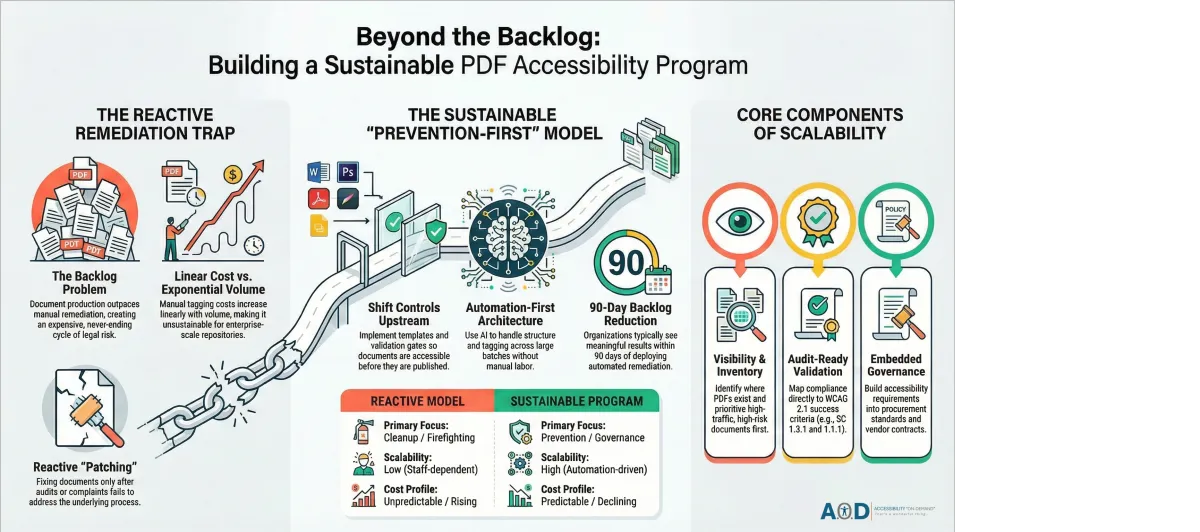
PDF accessibility has a backlog problem. Teams remediate documents after complaints surface, audits flag gaps, or legal exposure creates urgency. Then more PDFs get published. The backlog grows. Remediation starts again. For CIOs managing document portfolios across large organizations, this cycle is familiar and expensive.
The question is not whether to address PDF accessibility. ADA Title II enforcement timelines are set. Section 508 requirements are in effect. The DOJ has made plain that digital documents are in scope. The question is whether your organization's approach can truly scale, or whether it is funding an open-ended remediation cycle with no defined exit.
Reactive PDF Remediation Always Loses the Race
Reactive remediation is how most organizations start. A complaint arrives, an audit identifies problems, or a legal team flags exposure. IT fixes the specific documents in question, and the immediate risk is contained. But the underlying system hasn't changed.
The PDFs that triggered the complaint were created, reviewed, and published without accessibility controls. More PDFs will be created the same way tomorrow. As long as the authoring and publishing process remains unchanged, remediation will always trail behind production.
The cost problem compounds quickly. Manual remediation, which involves tagging document structure and alt text after the fact, does not scale without linear cost increases. Large organizations maintain tens of thousands of PDFs across websites, intranets, and vendor systems. Remediating each one individually is not a viable operating model at that volume.
CIOs have solved this pattern before. The shift from reactive patching to proactive controls changed cybersecurity risk posture permanently. Moving from data cleanup to upstream data quality standards eliminated recurring data debt in governance programs. PDF accessibility follows the same logic: sustainability requires control at the source, not more remediation downstream.
Prevention Is the Only PDF Accessibility Model With a Finish Line
A sustainable program starts upstream. The goal is not to eliminate remediation entirely, since legacy document repositories will always require some work, but to ensure that new PDFs arrive in a compliant state so the backlog has a ceiling rather than an open end.
That requires two things working in parallel. First, authoring tools and publishing workflows need to enforce accessibility by default: templates that produce tagged PDFs, export settings that require accessibility metadata, and validation gates before documents go live. Second, ownership needs to be explicit. Accessibility does not hold without someone accountable for standards, enforcement, and ongoing measurements.
When new documents are accessible by default, the remediation backlog shrinks to a finite, workable size. IT shifts from constant firefighting to managed execution against a declining inventory. That represents a fundamentally different operational posture, one that budgets predictably and reports measurable progress.
Core Components of a Scalable PDF Accessibility Program
Building a program that holds up at enterprise scale requires several foundational elements, and the order in which they are built matters.
Visibility. CIOs need to know where PDFs exist, how they are used, and which documents carry the greatest compliance risk. Without a centralized inventory, prioritization is guesswork. High-traffic documents with poor accessibility scores need to be addressed before low-volume, low-risk files, not the other way around because a complaint happened to come in first. Alternatively, an automated strategy addressing all documents may best deliver the optimal customer performance balance.
Automation. Manual remediation can address targeted, high-priority documents. It cannot keep pace with a large repository. Automation handles the consistent, repeatable work at scale, including document structure, reading order, alt text, and tagging, without proportional increases in cost or labor. It is the mechanism that makes volume manageable.
Compliance validation. Pass/fail checks aren't enough. Documents need to be validated against specific WCAG 2.2 success criteria: SC 1.3.1 (Info and Relationships), SC 1.1.1 (Non-text Content), SC 2.4.6 (Headings and Labels), and SC 4.1.2 (Name, Role, Value) for form fields. Validation output needs to be audit-ready documentation that holds up in front of a regulator, not just an internal dashboard indicator.
Governance. Standards enforced through policy but not through process erode. Document authors turn over. Vendors publish new content. Departments work independently. Governance means embedding accessibility requirements into procurement standards, vendor contracts, and publishing workflows so the program holds without depending on individual awareness.
Reporting. CIOs need to demonstrate measurable progress to legal teams, executives, and external auditors. That means compliance trends over time, remediation volumes, and outstanding risk by document category, not just a statement that a program exists.
WCAG 2.2 Compliance Requires a Platform, Not a Point Solution
Not every PDF tool is built for enterprise scale. When evaluating platforms, a few capabilities separate operational tools from point solutions.
Automation-first architecture is the threshold question. A platform that requires significant manual effort per document has not solved the scale problem; it has digitized it. The right platform processes large document batches and applies consistent remediation logic without manual review at every step.
OCR capability matters for legacy content. A substantial share of older PDFs are image-based, meaning documents scanned to PDF without usable text layers. Proper remediation requires OCR that accurately reconstructs reading order, identifies headings and tables, and produces a properly tagged document structure. Accuracy varies significantly across tools, and inadequate OCR means the remediated document remains unusable.
Compliance scoring should map to named standards, not proprietary metrics. Scores need to reference specific WCAG 2.2 success criteria and produce output that stands up to external audit review. Internal confidence is not the same as external defensibility.
Usability validation is frequently overlooked. A document can pass automated compliance checks and still fail a screen reader user if reading order is incorrect, if tables lack proper header associations, or if form fields are not labeled. The standard is not technical tagging. It is whether the document is genuinely usable by someone relying on assistive technology.
When IT Stops Firefighting: PDF Accessibility as a Governed Capability
When PDF accessibility is automated and governed, the IT role changes. Instead of processing one-off remediation requests, CIOs manage a system. Budgets become predictable. Risk decreases as the backlog declines and new documents arrive in compliant state. Executive stakeholders gain a reportable compliance posture they can stand behind.
The shift that makes accessibility sustainable is not remediating every document once. It is building conditions where accessible documents are the default output. Organizations that reach that point do not have better remediation teams. They have better systems.
If your organization is still processing the same types of remediation requests cycle after cycle, that is a system problem, not a staffing problem. Schedule a Program Strategy Call with Accessibility on Demand to see how CIOs are building scalable, prevention-first PDF accessibility programs.
Frequently Asked Questions
What WCAG success criteria apply to PDF accessibility?
PDF accessibility is governed by WCAG 2.2. Several success criteria apply directly to documents: SC 1.3.1 (Info and Relationships), SC 1.1.1 (Non-text Content), SC 2.4.6 (Headings and Labels), and SC 4.1.2 (Name, Role, Value) for interactive form fields. Both ADA Title II and Section 508 reference WCAG 2.2 as the applicable technical standard for digital content, including PDF documents on government and federally funded websites.
How long does it take to build a sustainable PDF accessibility program?
Timeline depends on document volume, existing infrastructure, and automation coverage. Organizations typically see meaningful backlog reduction within 90 days once automation is deployed. Governance frameworks, including authoring standards, publishing workflows, and vendor requirements, take longer to embed but produce the most durable long-term results. Prevention-first controls take more time to stand up than remediation tools and deliver greater return on that investment.
What is the difference between PDF remediation and PDF accessibility compliance?
Remediation is the technical work of tagging and repairing a PDF to meet accessibility standards. Compliance means the document satisfies the requirements of a specific standard, whether WCAG 2.2, Section 508, or ADA Title II, and can be validated as such. Remediation is the process; compliance is the measurable outcome. Not all remediation produces audit-ready compliance, which is why the validation methodology a platform uses matters as much as its remediation capability.
Next in the Series
Look for Week 11 in our 12-part IT Leadership Blog series: "IT Is Not the Digital Accessibility Compliance Bottleneck. The DOJ Extension Gives CIOs Time to Prove It."
About Accessibility on Demand™
Automation-first by design, not by compromise.
Accessibility on Demand™ (AoD™) is an enterprise-grade, automation-first PDF accessibility remediation platform. AoD™ aligns documents to WCAG and PDF/UA standards and supports compliance with Section 508, ADA Title II and III, and AODA requirements through a scalable, repeatable remediation framework.
The platform converts inaccessible PDFs into structured, audit-ready files in minutes, reducing dependency on manual services and significantly lowering total remediation costs. AoD™ provides organizations with measurable, consistent, and defensible accessibility outcomes suitable for regulatory scrutiny and internal audit review.
AoD™ Enterprise Capabilities:
Seamless integration with existing workflows and IDP stacks
High-volume batch processing for large files and document repositories
Third-party validation with WCAG and PDF/UA compliance scoring
Section 508 and ADA-aligned outputs with audit-ready reporting
Dedicated account management and enterprise support
Comprehensive onboarding and platform training
For Remediation Professionals:
AoD™ handles over 95% of the heavy lifting (automated tagging, reading order, contextual alt-text metadata, and structure) and delivers a complete tag tree, so accessibility specialists can still make subjective refinements and advanced remediation decisions where needed, rather than spending time on repetitive manual work.
Beat the Deadlines: Talk with a PDF Accessibility Specialist
The bar for IT accessibility in the public sector is rising. If your organization is navigating ADA compliance, WCAG requirements, or Section 508 accessibility and struggling to understand what applies to your PDF documents. Discover how AoD™ can ensure your organization stays ahead of accessibility deadlines, clarify scope, risk, and next steps.
External Links to Learn More About AoD:
To watch a 3-minute video about our AoD™ Solution, visit our Homepage: Accessibility On Demand (opens in new tab)
If you need help navigating ADA Title II regulations, please reach out to us to book a session:
Enterprise Contact Form (opens in new tab)
To Sign-up for a free trial of AoD, visit: Book a Demo (opens in new tab)
External Link to AoD’s "IT Leadership Blog" Series: Accessibility Insights
Week 1 - “Why PDF Accessibility Lands on IT's Desk"
Week 2 - “Why ‘Tagged PDF’ Does Not Mean WCAG Compliant: PDF Accessibility Requirements Explained"
Week 3 - “The Accessibility Triple Play: What PDF Accessibility Really Means for IT Leaders"
Week 4 - “Enterprise PDF Accessibility at Scale: A Governance Framework for CIOs"
Week 5 - "Manual vs. Automated PDF Accessibility Remediation: Automation Is the Only Model That Scales"
Week 6 - "Decentralized PDFs: A Centralized Accessibility Crisis"
Week 7 - "Third-Party PDFs and Accessibility Compliance: Who Owns the Risk?"
Week 8 - "When Forms Fail, Compliance Follows: The CIO's Hidden Accessibility Liability"
Week 9 - "Designing for Outcomes, Not Scores"
Week 10 - “Stop Remediating PDFs. Build a Sustainable PDF Accessibility Program Instead."
External Links to Other Great AoD Blogs You Don't Want to Miss:
Blog: "The 2.5 Trillion PDF Problem" (opens in new tab)
Blog: "Breaking the PDF Barrier: How Your Agency Can Beat ADA Compliance Costs" (opens in new tab)
Blog: "Understanding ADA Title II Exceptions" (opens in new tab)
External Links to Additional Resources:
W3C: Web Content Accessibility Guidelines (WCAG) 2.2 (opens in new tab)
Section 508 Standards: https://www.section508.gov/ (opens in new tab)
ADA: Exceptions (opens in new tab)
First Steps Toward Compliance: https://www.ada.gov/resources/web-rule-first-steps/ (opens in new tab)
DOJ Title II Web Accessibility Final Rule: https://www.ada.gov/resources/2024-03-08-web-rule/ (opens in new tab)
