What Happens When Your Compliance Score Meets an Auditor: axesPAC Validation, Process Documentation, and the Gap Between Them
By Accessibility on Demand | A Netra Labs Publication | Technical Implementation Series | Article 3
Every PDF accessibility platform produces a compliance score. Not every score means the same thing. The distinction between a score that withstands regulatory review and one that does not depends on what was measured and at what granularity.
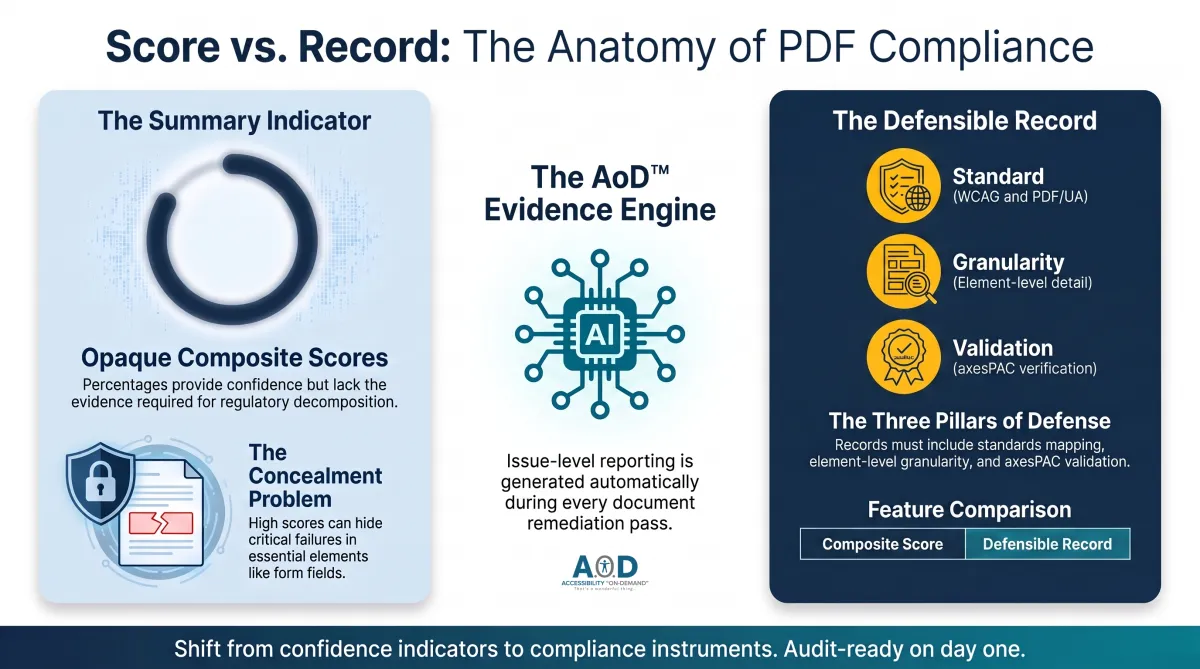
A compliance score is only as useful as the questions it can answer when challenged. An ADA investigator, an OCR reviewer, or opposing counsel in accessibility litigation does not need to know that a document is 94% accessible. They need to know which success criteria passed, which failed, at which elements, against which standard, and validated by which method. In a regulatory context, the response is not a number. It is a record.
A composite percentage does not answer those questions. It indicates that something was checked and most of it passed. That is a confidence indicator. A compliance record serves a different function.
The Anatomy of a Defensible Score
A defensible compliance score answers three questions without requiring additional documentation: against what standard was the document checked, at what granularity were results reported, and what method was used to validate the output. Each question represents a layer of the evidentiary record. A score that does not address all three functions is more as a confidence indicator than a compliance instrument.
The first question matters because ADA Title II and the EU Accessibility Act rely on different accessibility frameworks and technical references. Title II’s 2024 Final Rule references WCAG 2.1 AA. The EU Accessibility Act is commonly implemented through EN 301 549 v3.2.1, whose Chapter 10 governs electronic documents, including PDFs. PDF/UA, ISO 14289, is the document structure standard that independent validators like PAC evaluate.
A platform that scores against only one of these frameworks may leave an entity without a clean response to findings under the others. Accessibility on Demand™ (AoD) can present reporting mapped to WCAG 2.1 AA and PDF/UA in parallel. A single compliance report can address findings under both frameworks without requiring separate remediation passes or platform switches.
The Limits of Composite Scores
A composite accessibility score takes multiple criterion results, weights them by an internal methodology, and returns a single number. The issue is opacity. The number cannot be decomposed without access to the platform’s weighting logic, which the entity’s compliance team does not own and cannot present to a reviewer. When challenged, the score does not explain itself.
When a regulator requests compliance documentation for a specific document, the review often does not stop at the score. The reviewer will examine the document against specific success criteria. If it fails SC 1.3.1 because a table lacks header associations, the entity needs a record showing that criterion was tested, the result for that specific element, and the remediation applied. A composite score does not provide that detail. What it produces is a number the entity must then work backward from under time pressure, reassembling underlying data that should have been captured at the point of remediation.
There is also a concealment problem. A document with 200 passing elements and 5 critical SC 4.1.2 failures on form fields might score 97.5% on a composite metric. An entity presenting that score in response to a complaint about inaccessible form fields may still need to explain why the score was high while the forms were broken. Issue-level reporting would surface the SC 4.1.2 failures directly and drive remediation of those fields.
What Issue-Level Reporting Captures
Issue-level scoring reports compliance status for each applicable success criterion, at each element where a failure was found, with enough specificity to support targeted remediation and response to a specific finding.
For PDFs, the success criteria that carry the most compliance weight are:
SC 1.1.1 (Non-text Content): Every non-decorative image should carry alt text that serves an equivalent purpose. The compliance record shows which figures have alt text, which are marked as decorative artifacts, and which are missing coverage.
SC 1.3.1 (Info and Relationships): Document structure should be programmatically determinable. The record shows heading hierarchy, table structure, list markup, and elements that convey structural meaning visually but lack corresponding tags.
SC 1.3.2 (Meaningful Sequence): Reading order should be programmatically determinable. The record shows the tag tree sequence and any elements flagged for reading order review.
SC 2.4.6 (Headings and Labels): Headings and labels should be descriptive. The record shows each tagged heading and its level.
SC 4.1.2 (Name, Role, Value): Every form field should have a programmatic name, an identified role, and a mechanism to set its value. The record shows each form field, its label, its role, and its individual compliance status.
The output for each criterion includes pass or fail status, element-level detail for failures, and the remediation action taken. That record is what an auditor needs. It is also what legal teams need when responding to a complaint.
The Value of Third-Party Validation
PAC, PDF Accessibility Checker, is commonly used for PDF accessibility and PDF/UA validation. Accessibility auditors, ADA reviewers, and compliance offices use it as an independent check.
Third-party validation adds something platform self-scoring cannot: independence. When compliance documentation relies solely on the score produced by the same platform that performed the remediation, that documentation is self-reported. A PAC validation run against the remediated document by the entity or a third party provides independent evidence of PDF/UA conformance.
PAC states that machine checking is useful for technical aspects of PDF accessibility, but it cannot replace a final human check, and its process includes both automated checks and visual review functions. AoD’s compliance validation is powered by axesPAC, built on the PAC engine, which maps to the structural criteria PAC evaluates, including tag tree completeness, heading hierarchy, table header associations, alt text coverage, form field labeling, and document metadata.
Building the Record Before Anyone Asks
The organizations that handle accessibility audits efficiently have the compliance record assembled before the audit request arrives. This is not just a contingency posture. It is a workflow decision made at the point of implementation.
In the reactive model, an audit triggers a scramble. Documents are pulled, checked, reports generated, and documentation assembled under time pressure. Errors, inconsistencies, and gaps in the historical record can create exposure that would not have existed under continuous documentation. Legal review of assembled-after-the-fact compliance materials is usually slower and more expensive than producing records that already exist.
Continuous compliance means the compliance record is a byproduct of the remediation workflow. Every document processed by AoD generates an issue-level compliance score report stored alongside the remediated file. When an audit arrives, the entity retrieves the report for the document in question. The record already exists, in the format an auditor needs, without additional assembly.
This is the practical case for issue-level reporting: the record should be complete enough to defend on day one of an audit. A composite score is not complete enough. An issue-level report structured for external review is.
Frequently Asked Questions
What is issue-level PDF accessibility compliance scoring and why does it matter for audits?
Issue-level scoring reports compliance results individually for each WCAG success criterion and each element where a failure was found. Rather than producing a composite number, it produces a record that traces which criteria passed, which failed, and at which elements. When a regulator examines a specific complaint about a specific document, the review goes to the criterion level. A composite score does not support that trace. Issue-level output can.
How does PDF/UA validation differ from WCAG 2.1 AA compliance testing?
WCAG 2.1 AA is a content accessibility standard that addresses how information is conveyed to users. PDF/UA, ISO 14289, is a document structure standard that governs how a PDF artifact is built. WCAG asks whether a user can access the information. PDF/UA asks whether the document’s internal architecture supports that access correctly. A document can satisfy most WCAG criteria and still fail PDF/UA because its tag tree is incomplete, its heading hierarchy skips levels, or its tables lack programmatic header associations. Defensible compliance for PDFs under Title II requires validation against both.
What is the difference between a compliance score and a compliance record?
A compliance score is a summary indicator. A compliance record is the documentation that supports it. A score says a document passed. A record says what was tested, at what granularity, against which criteria, by what method, and on which date. In a regulatory context, the score is only as useful as the record behind it. An entity that can produce a score but not the underlying record may have difficulty responding meaningfully to a specific finding.
About Accessibility on Demand™
Automation-first by design, not by compromise. Delivering compliance, speed, and cost-savings in one solution.
Accessibility on Demand™ (AoD) is an enterprise-grade, AI-powered PDF remediation platform designed for automation-first accessibility workflows, helping organizations make inaccessible PDFs compliant, audit-ready assets at scale without operational friction.
For organizations where accessibility is a strategic priority, AoD brings precision, speed, and control to a process that is too often fragmented and costly. It converts PDFs into WCAG 2.1 Level AA, PDF/UA, ADA, and Section 508-aligned documents in minutes, with up to 95% automation, delivering both measurable cost reduction and defensible compliance evidence.
Built for CIOs, IT leaders, and accessibility teams, AoD replaces labor-intensive remediation with intelligent automation across OCR, document structure tagging, reading order, meaningful alternative text, complex tables, formulas, and fillable forms. The result is a refined, scalable compliance operation that supports consistency, efficiency, and long-term governance.
AoD deploys as a self-service portal or integrates directly into enterprise document management and intelligent document processing pipelines via API, embedding accessibility upstream and preserving continuity across existing workflows.
AoD serves organizations across SLED, healthcare, federal government, higher education, financial services, insurance, and legal sectors, where document complexity is high, compliance expectations are rising, and the cost of inaccessibility is meaningful.
For organizations navigating ADA Title II, ADA Title III, Section 504, Section 508, AODA, and evolving accessibility requirements, AoD offers a partner-neutral path to compliance defined by precision, scalability, and measurable business impact.
Enterprise capabilities
API integration for upstream remediation within existing workflows and IDP stacks.
High-volume batch processing for large files and repositories.
Third-party validation with WCAG and PDF/UA compliance scoring.
Section 508- and ADA-aligned outputs with audit-ready reporting.
Dedicated account management and enterprise support.
Comprehensive onboarding and platform training.
For remediation professionals
For remediation professionals, AoD is built for the scale of what comes next. It handles the majority of the heavy lifting, including automated tagging, reading order, contextual alt-text metadata, and document structure, then delivers a complete tag tree so specialists can focus on the judgment, nuance, refinement, and governance decisions. At the center of accessibility is one essential truth: documents must be genuinely usable for the people who depend on them. Together, we can take on the trillions of pages ahead and raise the standard for what accessibility can be.
Beat the Deadlines: Talk with a PDF Accessibility Specialist
The bar for IT accessibility in the public sector is rising. If your organization is navigating ADA compliance, WCAG requirements, or Section 508 accessibility and struggling to understand what applies to your PDF documents. Discover how AoD can ensure your organization stays ahead of accessibility deadlines, clarify scope, risk, and next steps.
Convenient External Links to learn more:
Visit our Homepage and watch the AoD Demo (2min 33sec)
Enjoy AoD's Blog: Accessibility Insights
To Sign-up for a free trial of AoD or need help navigating ADA Title II regulations, visit: Book a Demo
External Links to Additional Resources:
W3C: Web Content Accessibility Guidelines (WCAG) 2.1
Section 508 Standards: https://www.section508.gov/
ADA: Exceptions
First Steps Toward Compliance: https://www.ada.gov/resources/web-rule-first-steps/
DOJ Title II Web Accessibility Final Rule: https://www.ada.gov/resources/2024-03-08-web-rule/
