Who Learns to Scale Judgment First: What SLED, Financial Services, and Healthcare Can Take From Commercial Insurance's AI Shift
By Accessibility on Demand | A Netra Labs Publication | Technical Implementation Series | Article 9
Alpesh Patel, CRO at Outmarket AI, titled his June 1, 2026 LinkedIn article "Winning Battles, Losing the War: The Most Dangerous Position in Commercial Insurance AI Is Thinking You're Ahead."¹ His argument opens with results that are hard to dismiss: commercial insurance agencies issuing certificates in hours rather than days, cutting error rates by two thirds, and winning a $500,000 account because AI caught a risk that years of human review had missed. Each outcome is real. None of it, Patel argues, is the war that matters most.
He points to an agency owner planning to grow organically from $100 million to $250 million, not through longer hours, aggressive hiring, or thinner service, but by scaling expertise, judgment, service quality, and risk intelligence. That is a different conversation than most agencies are having.
It is the conversation digital accessibility leaders need to have too. The opportunity is not just faster PDF remediation. It is redesigning how accessibility expertise operates across the organization, so it does not stay confined to a handful of specialists or arrive only after someone hits a barrier. Scaling judgment, not just processing more documents, is the real question.
That distinction extends well beyond insurance. Set it against SLED, financial services, or healthcare, and the pattern holds exactly.
Winning the Battle, Losing the War
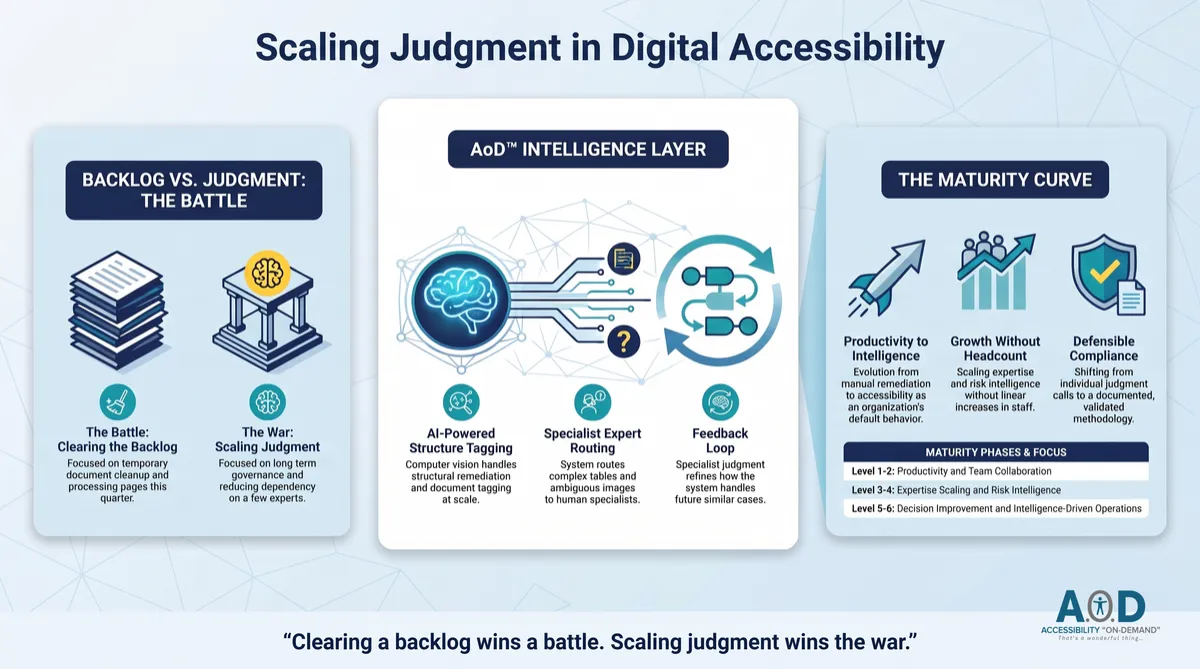
In digital accessibility, the visible battle is clearing a remediation backlog faster than it refills. Organizations track documents processed this month, pages cleared this quarter, turnaround time down from weeks to days. The numbers move. The queue shrinks. It looks like progress, and it is, but it is not the whole picture.
A high-priority form remediated before enrollment closes matters. A bank statement issued in an accessible format on time matters. A patient who can read discharge instructions with a screen reader, without requesting an alternate format, feels the value immediately.
Still, an organization can win every backlog battle and lose the larger war. The real question is whether it can produce accessible documents consistently, without relying on the two or three people who know how a screen reader navigates a table, why a form's tab order matters, when an image needs meaningful alternative text, or how to spot a technically tagged file that is still hard for a real user to understand.
That backlog was a symptom. The real problem was how much depended on two or three people who happened to know the material.
That is Patel's warning translated into accessibility terms. A workflow that gets a little faster can look like being ahead, while another organization redesigns how accessibility expertise operates across the business: embedding checks at upload or publication, applying repeatable structural remediation automatically, routing ambiguous cases to qualified people, validating outputs, and keeping a record of what was reviewed and changed.
One organization has a faster queue. The other has built a more capable operating model, and for the end user, that difference is what actually matters. Accessible documents are there when needed, work with assistive technology, and can be read, navigated, understood, and acted on without anyone having to report a barrier after the fact.
That shift, from speeding up individual tasks to operationalizing expertise, is why knowing the accessibility standards is no longer enough on its own.
Why Knowledge Stopped Being the Advantage
Patel makes an observation about insurance brokers that transfers directly to accessibility. Knowledge used to be the advantage. A broker who understood coverage exclusions and claims exposure better than the client earned the business.
Now a client can ask an AI model to explain a coverage gap in seconds. Knowledge is more available than it used to be. Execution is the advantage that is left.
Accessibility is following the same path. WCAG success criteria are public. Automated checkers are everywhere. Anyone can run a scan and get a pass or fail. What a scan cannot reliably tell you is whether a document that technically passes is one a person who is blind or has low vision can actually navigate, understand, and use without losing their place.
It cannot always tell you whether alt text explains what an image is for rather than just describing its pixels, whether a complex table still makes sense read cell by cell through a screen reader, whether the reading order holds up once the visual layout is gone, whether a fillable form can be completed efficiently with a keyboard alone, or whether a title, language setting, heading structure, and set of link text actually help someone orient themselves. A PDF that clears an automated check can still be confusing, incomplete, or unusable in practice.
That is where judgment remains scarce.
Automation was never meant to replace accessibility expertise; it exists to extend that expertise across documents and workflows no specialist could review one at a time. In Patel's terms, the advantage goes to the organization that turns specialized knowledge into an operating capability instead of leaving it locked inside a few individual experts.
The Six Levels of Maturity
Patel’s six levels of AI maturity translate to digital accessibility with real precision, moving from processing work faster to making accessibility a dependable part of how the organization runs.
Level 1: Productivity
Computer vision and document intelligence read structure and apply remediation at scale. Batches of forms, notices, statements, and reports move through in hours instead of weeks, with no one writing a new rule by hand for every incoming document. It is real progress, and still just the start.
Level 2: Collaboration
IT, compliance, content, communications, and accessibility teams work from a shared inventory and a shared definition of what accessible delivery requires, instead of each department defining "accessible" its own way. Remediation criteria, validation expectations, and publishing decisions align across the document lifecycle rather than getting handed off at the end.
Level 3: Expertise Scaling
Documents a system cannot resolve on its own, an ambiguous image, a complex chart, an irregular table, a technical formula, a form with unclear field relationships, get routed to a qualified specialist. That specialist's judgment does not stay locked inside one person's experience. It shapes how similar documents get handled the next time, which is what it actually means to scale expertise instead of just processing volume.
Level 4: Risk Intelligence
Automation flags a broken tab order, a missing form label, an incorrect heading hierarchy, an inaccessible scan, or a missing document language before a constituent, patient, customer, student, employee, regulator, or opposing counsel finds it first. In Patel's insurance example, risk intelligence catches the coverage issue before it becomes a claim. In accessibility, it catches the document barrier before it becomes an exclusion, a complaint, a missed deadline, or legal exposure.
Level 5: Decision Improvement
Leadership works from actual operational evidence instead of estimates: which document types create the most exceptions, which departments generate the largest volume of inaccessible files, where human review is needed most, where publishing controls need to be stronger. Instead of asking which backlog to clear next, leaders can ask which document types create the greatest risk, which workflows keep introducing barriers, which high-volume documents should be remediated automatically at upload, and what records need to be kept to support accountability. A documented remediation and validation history also gives an organization a stronger position when it has to explain how a document was assessed, remediated, reviewed, and published.
Level 6: Intelligence-Driven Operations
Accessible delivery becomes the organization's default behavior: built into publishing workflows, document management systems, portals, customer communications, and high-volume production, rather than a project someone remembers to start before a deadline. Accessibility no longer depends on an urgent escalation or one specialist being available. The organization has designed its workflows so accessible delivery is routine, measurable, and repeatable.
Put together, the six levels describe an organization that works differently, not just faster.
Service Is Becoming the New Sales
Patel argues that service is becoming the real differentiator. Customers rarely stay loyal because of a presentation or a promise. Trust gets built in the moment an organization catches a problem before the customer has to feel it.
Digital accessibility has its own version of that moment, and it happens every day. A parent finishes a school enrollment form because the district's PDF works with a screen reader on the first try. A patient reads discharge instructions correctly because the document's headings, reading order, and form fields were built right from the start, not patched after a complaint. A veteran completes a benefits application alone, without waiting on hold for someone to read the form aloud. A customer opens a bank statement the day it is issued instead of requesting an alternate format and waiting a week. A policyholder reads an insurance notice, understands the options, and acts on it without needing someone else to interpret a poorly structured document.
None of these people ever see the remediation workflow, the validation process, the exception queue, or the specialist review behind the result. They experience one thing: whether the document works.
That is the service standard that matters. Accessibility builds trust before someone has to ask for help, file a complaint, or disclose a barrier.
What Scaling Judgment Is Worth
The agency owner from Patel’s opening example was not scaling through headcount. He was scaling expertise, judgment, service quality, and risk intelligence, and the same arithmetic applies to accessibility.
An organization that scales judgment does not need a new remediation specialist for every increase in document volume. Enrollment forms, benefit applications, public notices, financial statements, claims correspondence, healthcare records, and internal policies can grow without the review team growing at the same pace.
The return shows up in a few places. For SLED organizations, the timing matters most. The DOJ's ADA Title II rule sets compliance deadlines beginning in April 2027 for larger public entities and April 2028 for smaller ones, with covered web content and mobile applications expected to meet WCAG 2.1 Level AA unless a limited exception applies. Public PDFs and other conventional electronic documents remain part of that challenge, especially when they deliver services, programs, benefits, applications, and public information.
Every inaccessible public-facing document is one a constituent, patient, customer, regulator, or opposing counsel might find before the organization does. Scaled judgment changes that order. It surfaces the gap earlier, the same way Patel's risk-intelligence level catches a coverage issue before it becomes a claim.
It also changes an organization's position when it has to account for its decisions. A team that can show a documented methodology, a remediation history, a validation record, and an exception process stands in a fundamentally different place than one relying on informal, unrecorded judgment calls.
This does not replace the outcomes that matter most: the parent, patient, veteran, customer, or employee who can use the document on their own. It is what makes those outcomes ordinary instead of occasional.
From Document Backlogs to Accessible Operations
Automation was never meant to replace the specialists whose knowledge of assistive technology, document semantics, reading order, tables, forms, and user experience lets them make difficult accessibility calls correctly. Its purpose is to put that judgment where specialists cannot personally be, across high-volume document flows, recurring publication cycles, legacy repositories, and enterprise workflows that generate more PDFs than any manual team could reasonably review one at a time.
AoD applies automation to the repeatable structural work and reserves human attention for the ambiguity and nuance that need it. It supports remediation and validation inside existing workflows, moving organizations from a queue they clear project by project toward a model where accessibility gets applied earlier and held to consistently.
For the organization, that value is concrete: a remediation operation that scales through expertise as much as headcount, faster access to documents people can actually read and use with assistive technology, earlier identification of accessibility risk, more consistent document structure and validation, records that explain what happened to a document and why, and a clear path from individual remediation wins to an accessibility operation that holds up over time.
The organizations that lead in digital accessibility will not necessarily be the ones remediating the highest number of documents this quarter. They will be the ones who work out how to scale judgment first, so usable documents reach the people who depend on them, consistently and without delay.
¹ Alpesh Patel, “Winning Battles, Losing the War,” LinkedIn, June 1, 2026. Subtitle: “The Most Dangerous Position in Commercial Insurance AI Is Thinking You're Ahead.”
See AoD™ with your own documents
Clearing a backlog wins a battle. Scaling the judgment behind it wins the war.
Bring a selection of representative PDFs, and our team will show you what a one-to-two-click workflow looks like in practice. Book a demo to see how AoD™ helps your accessibility team close the gap faster.
Visit https://accessibilityondemand.ai/book-aod-session to book a session with our team and visit accessibilityondemand.ai to explore our website.
About Accessibility on Demand™
Automation-first by design, not by compromise. Delivering compliance, speed, and cost-savings in one solution.
Accessibility On-Demand™ (AoD™) is an enterprise-grade PDF remediation platform built for precision, efficiency, and control. Designed for CIOs, IT leaders, and accessibility teams, AoD™ combines automation, intuitive functionality, and reporting to support document accessibility at scale.
AoD™ applies 100% automation to PDF remediation process, with over 95% of checks receiving a passing result against WCAG 2.1 Level AA and PDF/UA criteria when evaluated using third-party validation tools such as axes4 PAC. This substantially reduces manual effort, allowing teams to focus on review and the end-user experience.
Accessibility extends beyond validation scores. AoD™ addresses high-accuracy OCR, document structure tagging, reading order, meaningful alternative text, complex tables, and formulas. Our new fillable forms remediation feature brings interactive PDF forms into the same workflow.
Every function is within one or two clicks. We work closely with customers to refine features and simplify daily remediation, respecting the time of accessibility teams and the needs of the people using their documents.
Available through a self-service portal or API integration, AoD™ fits into enterprise document management and intelligent document processing workflows.
ADA Title II digital accessibility deadlines cover web content, mobile apps, and covered PDF documents:
April 26, 2027: State and local governments with populations of 50,000 or more.
April 26, 2028: Governments with populations below 50,000 and all special district governments.
Covered content must meet WCAG 2.1 Level AA, subject to specified exceptions.
AoD™ serves government, education, healthcare, financial services, insurance, and legal organizations, supporting PDF accessibility efforts related to ADA Title II and Title III, Section 504, Section 508, AODA, and other applicable requirements.
Our purpose is clear: make accessibility work easier to manage and information easier for everyone to use.
Enterprise capabilities
API integration for upstream remediation within existing workflows and IDP stacks.
High-volume batch processing for large files and repositories.
Third-party validation with WCAG and PDF/UA compliance scoring.
Section 508- and ADA-aligned outputs with audit-ready reporting.
Dedicated account management and enterprise support.
Comprehensive onboarding and platform training.
For remediation professionals
For remediation professionals, AoD is built for the scale of what comes next. It handles the majority of the heavy lifting, including automated tagging, reading order, contextual alt-text metadata, and document structure, then delivers a complete tag tree so specialists can focus on the judgment, nuance, refinement, and governance decisions. At the center of accessibility is one essential truth: documents must be genuinely usable for the people who depend on them. Together, we can take on the trillions of pages ahead and raise the standard for what accessibility can be.
Convenient External Links to learn more about AoD:
Visit our Homepage and watch the AoD Demo (2min 33sec)
Learn more about PDF fillable form remediation: watch the AoD PDF fillable form demo (9min 9sec)
Enjoy AoD's Blog: Accessibility Insights
To Sign-up for a free trial of AoD or need help navigating ADA Title II regulations, visit: Book a Demo
External Links to Additional Resources:
¹ Patel, LinkedIn, June 1, 2026. Link to the article: "Winning Battles, Losing the War"
W3C: Web Content Accessibility Guidelines (WCAG) 2.1
Section 508 Standards: https://www.section508.gov/
ADA: Exceptions
First Steps Toward Compliance: https://www.ada.gov/resources/web-rule-first-steps/
DOJ Title II Web Accessibility Final Rule: https://www.ada.gov/resources/2024-03-08-web-rule/
