A Better PDF Experience Starts with the People Using It
By Accessibility on Demand | A Netra Labs Publication | Technical Implementation Series | Article 10
Each day, people open a PDF to accomplish something ordinary: reviewing a bill, reading a meeting agenda, completing a permit application, following instructions from a physician. For most, the task takes seconds. For a person navigating by screen reader or keyboard, the same moment depends entirely on how the document was built.
The Scale of the Opportunity
The World Health Organization estimates that 1.3 billion people experience significant disability. That represents 16% of the world’s population, or 1 in 6 people.[1]
1.3 billion people worldwide experience significant disability | 16% of the world’s population | 1 in 6 people, according to the World Health Organization |
Consider, too, the documents themselves. Adobe conservatively estimates that more than 3 trillion PDF files exist worldwide, and that number grows daily.[2]
Not every PDF is inaccessible, and not every person with a disability relies on assistive technology. Taken together, however, these figures describe an opportunity of remarkable scale: a vast population that depends on documents, and a body of documents that continues to expand.
Every PDF made accessible from the outset removes one barrier between a person and the information they need. That conviction is the reason AoD™ exists.
Why We Built AoD™
Accessibility on Demand™ was created to close this gap. Our focus rests on the end user: the person who opens a document and needs to read it, complete it, or act on it. When the document serves that person well, our work has succeeded.
That outcome begins one step earlier, with the professionals who prepare those documents. A remediation platform that is difficult to learn or cumbersome to manage slows accessibility work, and readers wait longer for the content they need. We therefore began with the accessibility team.
Effortless to Use, Effortless to Manage
The best product improvements start with a simple question: “What would make this easier for you?”
For AoD™, conversations with customers are an opportunity to understand more than a feature request. They reveal the work behind it: the documents a team handles, the steps that take too much time, and the questions that arise along the way.
That perspective shapes a customer-centered approach to improving features and user experience (UX). The goal is to make AoD™ clearer, more useful, and easier to fit into everyday work, with every new function earning its place.
One-Click Reading Order Correction
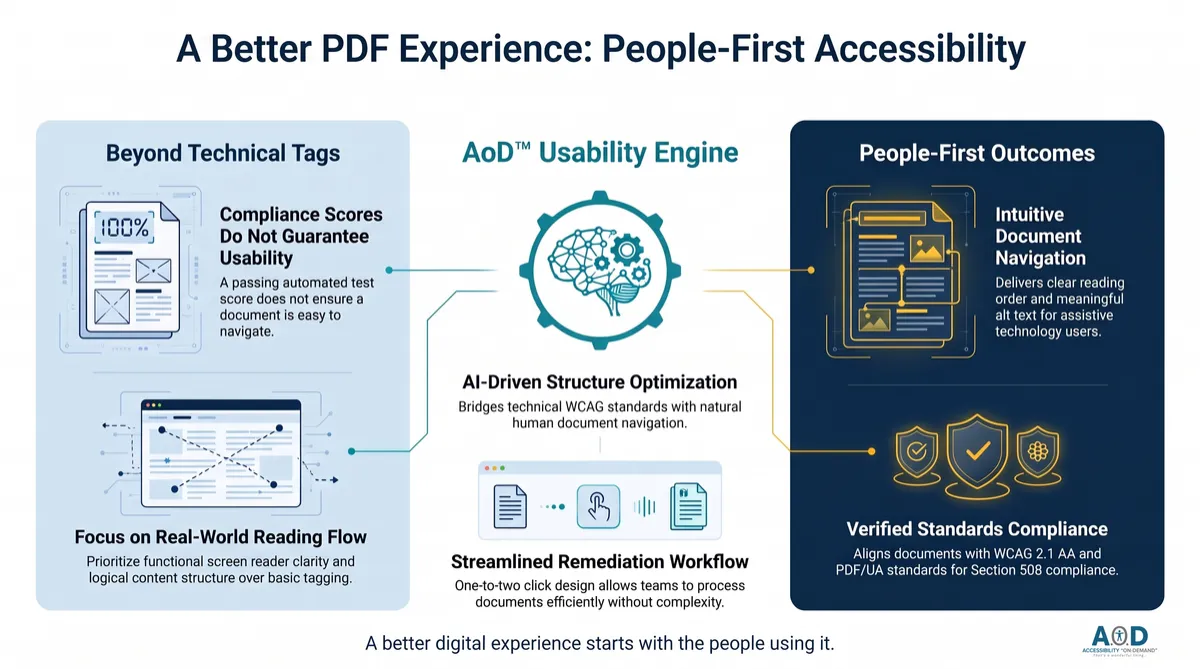
AoD™ is designed so that every function sits within one to two clicks. Teams locate what they need at once, spend less time learning the platform, and devote more of their attention to the documents that matter to their readers.
Reading order should help people follow a document naturally. With AoD’s Reading Order Hot Fix, a remediator can flag an issue with a single click. AoD™ then reassesses the reading order and applies the correction automatically, with no additional action required from the remediator.
Refining AoD™ in Partnership with Customers
We collaborate closely with our customers to refine the features that support their daily remediation work. Their insight reveals where a step can be shortened, a label made clearer, or a workflow brought to completion more quickly.
The objective is a platform that makes the work easier, more efficient, and timelier. When the accessibility team’s day runs smoothly, accessible documents reach readers sooner.
Documented Overrides for False Positives
Customer feedback also led to a clearer way to handle false positives from third-party accessibility checkers. When a reviewer determines that a flagged issue is a false positive, AoD™ allows the finding to be overridden and the decision documented. The override is disclosed in the certificate, preserving a transparent record for audit review rather than leaving an unexplained change in the results.
Recent Features and Upgrades
We continue to refine both the user experience and the processing behind it. Recent improvements reflect the practical needs our customers bring to us:
Hot Fix functionality: reduces manual effort by a further 80% in workflows where policy requires intervention.
Reading order consistency: reconciles the tag tree’s reading order with the Graphical Reading Panel to support more consistent review.
Fillable forms remediation: identifies missing form fields and applies automated remediation.
Higher-volume processing: infrastructure upgrades support concurrent transactions at scale and deliver a fivefold improvement in processing speed.
API integration: enables teams to connect AoD™ with their existing systems and incorporate PDF remediation into established document workflows.
Multi-user and team capabilities: AoD™ includes unlimited users and admins, making it easy to expand access across teams, departments, and locations without additional seat costs.
Closing the Digital Accessibility Gap
The distance between the people who need accessible information and the documents meant to serve them is considerable, yet it closes one document at a time. AoD™ addresses it from every side.
For accessibility teams: an automation-first platform that extends the reach of every remediator, aligning documents to WCAG 2.1 AA and PDF/UA standards in support of Section 508 and ADA Title II compliance.
For organizations: high-volume processing and audit-ready reporting that bring large document collections toward accessibility with measurable, consistent results.
For readers: documents carrying the structure that assistive technology relies on, so people can read, complete, and act on information independently.
We envision a world where people can access the information they need, when they need it, and where the professionals who make that possible are equipped with tools worthy of their work.
See AoD™ with your own documentsBring a selection of representative PDFs, and our team will show you what a one-to-two-click workflow looks like in practice. Book a demo to see how AoD™ helps your accessibility team close the gap faster. Visit https://accessibilityondemand.ai/book-aod-session to book a session with our team and visit accessibilityondemand.ai to explore our website. |
[1] World Health Organization, Disability (fact sheet, 7 March 2023), https://www.who.int/news-room/fact-sheets/detail/disability-and-health
[2] Adobe, Celebrating 30 years of digital transformation with Adobe Acrobat (15 June 2023), https://blog.adobe.com/en/publish/2023/06/15/celebrating-30-years-of-digital-transformation-with-adobe-acrobat
About Accessibility on Demand™
Automation-first by design, not by compromise. Delivering compliance, speed, and cost-savings in one solution.
Accessibility On-Demand™ (AoD™) is an enterprise-grade PDF remediation platform built for precision, efficiency, and control. Designed for CIOs, IT leaders, and accessibility teams, AoD™ combines automation, intuitive functionality, and reporting to support document accessibility at scale.
AoD™ applies 100% automation to PDF remediation process, with over 95% of checks receiving a passing result against WCAG 2.1 Level AA and PDF/UA criteria when evaluated using third-party validation tools such as axes4 PAC. This substantially reduces manual effort, allowing teams to focus on review and the end-user experience.
Accessibility extends beyond validation scores. AoD™ addresses high-accuracy OCR, document structure tagging, reading order, meaningful alternative text, complex tables, and formulas. Our new fillable forms remediation feature brings interactive PDF forms into the same workflow.
Every function is within one or two clicks. We work closely with customers to refine features and simplify daily remediation, respecting the time of accessibility teams and the needs of the people using their documents.
Available through a self-service portal or API integration, AoD™ fits into enterprise document management and intelligent document processing workflows.
ADA Title II digital accessibility deadlines cover web content, mobile apps, and covered PDF documents:
April 26, 2027: State and local governments with populations of 50,000 or more.
April 26, 2028: Governments with populations below 50,000 and all special district governments.
Covered content must meet WCAG 2.1 Level AA, subject to specified exceptions.
AoD™ serves government, education, healthcare, financial services, insurance, and legal organizations, supporting PDF accessibility efforts related to ADA Title II and Title III, Section 504, Section 508, AODA, and other applicable requirements.
Our purpose is clear: make accessibility work easier to manage and information easier for everyone to use.
Enterprise capabilities
API integration for upstream remediation within existing workflows and IDP stacks.
High-volume batch processing for large files and repositories.
Third-party validation with WCAG and PDF/UA compliance scoring.
Section 508- and ADA-aligned outputs with audit-ready reporting.
Dedicated account management and enterprise support.
Comprehensive onboarding and platform training.
For remediation professionals
For remediation professionals, AoD is built for the scale of what comes next. It handles the majority of the heavy lifting, including automated tagging, reading order, contextual alt-text metadata, and document structure, then delivers a complete tag tree so specialists can focus on the judgment, nuance, refinement, and governance decisions. At the center of accessibility is one essential truth: documents must be genuinely usable for the people who depend on them. Together, we can take on the trillions of pages ahead and raise the standard for what accessibility can be.
Convenient External Links to learn more about AoD:
Visit our Homepage and watch the AoD Demo (2min 33sec)
Learn more about PDF fillable form remediation and watch the AoD PDF fillable form demo (9min 9sec)
Enjoy AoD's Blog: Accessibility Insights
To Sign-up for a free trial of AoD or need help navigating ADA Title II regulations, visit: Book a Demo
External Links to Additional Resources:
W3C: Web Content Accessibility Guidelines (WCAG) 2.1
Section 508 Standards: https://www.section508.gov/
ADA: Exceptions
First Steps Toward Compliance: https://www.ada.gov/resources/web-rule-first-steps/
DOJ Title II Web Accessibility Final Rule: https://www.ada.gov/resources/2024-03-08-web-rule/
