AoD™ API Integration Is Changing the Future of PDF Accessibility
By Accessibility on Demand | A Netra Labs Publication | Technical Implementation Series | Article 1
Most organizations still treat PDF accessibility as something handled after publication, or worse, only after a complaint is filed. That approach makes accessibility harder to scale, harder to govern, and more expensive to fix.
A better model is to build remediation into the document pipeline itself. When accessibility is addressed upstream, before a file reaches publication, organizations can reduce risk at the source and create a more durable compliance process.
For CIOs, CAIOs, and digital accessibility leaders, this is not just about speed. It is about embedding accessibility into the enterprise architecture, where it belongs.
Where PDFs Enter the Workflow
The first question is simple: which systems generate PDFs at volume?
In most enterprises, the answer includes document management platforms, ERP systems, CMS workflows, and individual staff exports. SharePoint, SAP, Oracle, and website publishing tools may all be creating PDFs in different parts of the organization. If accessibility is only applied in one place, large parts of the document inventory can remain outside the compliance perimeter.
That is why an API that handles integration into workflows matters. It allows remediation to happen at the point where documents are created or published, not after the fact.
How Accessibility on Demand™ (AoD) API Architecture Works
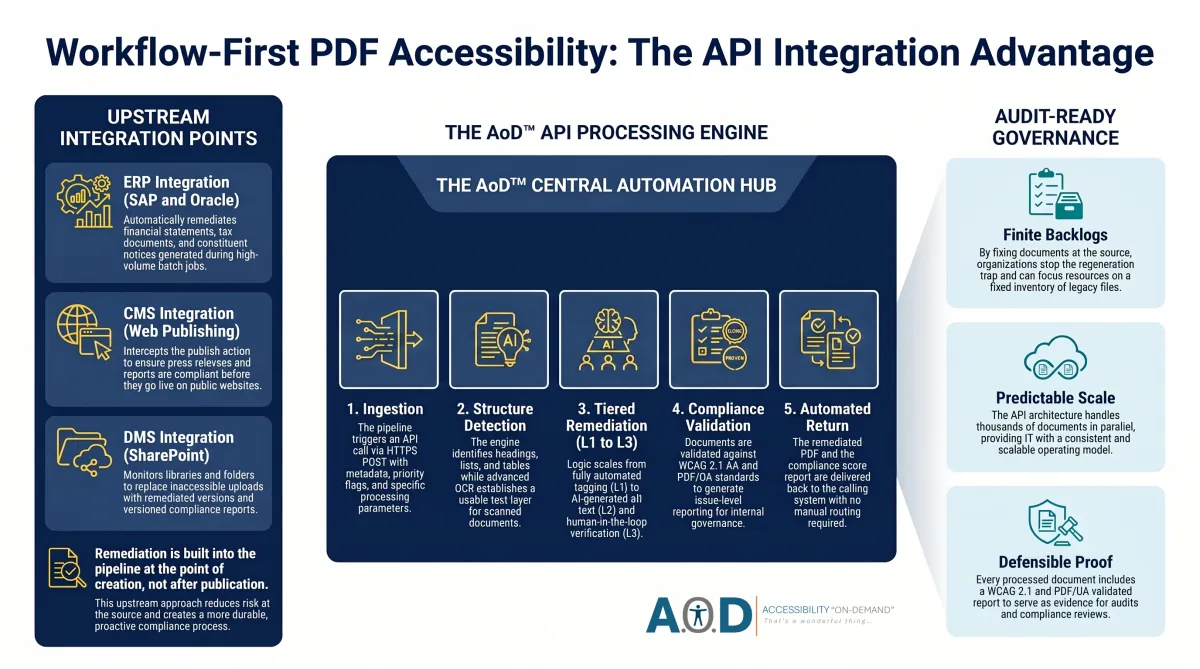
The AoD API is built to sit inside existing document pipelines as a processing step, not alongside them as a separate queue. The integration pattern is consistent across upstream systems.
Document ingestion: The pipeline triggers an API call at the point of PDF generation or export. The document is submitted via HTTPS POST with metadata, priority flags, and processing tier parameters. Single-document and batch submissions are both supported.
Structure detection: The AoD engine reads the raw PDF and builds a structural map before any remediation logic runs. It identifies headings, paragraphs, lists, tables, images, and form fields. For image-based PDFs such as scanned documents, advanced OCR runs at this stage to establish a usable text layer. Proper tag identification and corresponding reading order are established and computationally validated against the visual layout.
Tiered remediation: Remediation runs at one of three tiers (Level 1-3) based on document complexity or policy. Level 1 handles structurally straightforward documents through automated tagging. Level 2 adds structural correction and AI-generated alt text for multi-column layouts, embedded graphics, or ambiguous reading orders. Level 3 is reserved for cases where policy dictates a human in the loop, where every document must be verified manually.
Compliance validation: After remediation, the document is validated against WCAG 2.1 AA and PDF/UA. The output includes issue-level reporting for key success criteria related to structure, non-text content, headings, and form fields. The remediated PDF and structured compliance score report are returned together, giving organizations evidence for internal governance and future audits.
Return and delivery: The API returns the accessible PDF and compliance score report to the calling system. It goes back into the same pipeline that submitted it, with no separate queue, no secondary workflow, and no manual routing.
Document Management, ERP, and CMS Integration
Document management systems are where many public sector and enterprise PDFs are staged before publication. A document uploaded in an inaccessible state can be live on a public website within minutes.
The AoD API integrates with any document management system capable of triggering an HTTPS call on document events. When a PDF is added or modified in a monitored library or folder, the configured trigger submits it for processing, receives the remediated file and compliance score report, and writes both back to the originating system. The remediated PDF replaces the original, and the compliance report is stored as a versioned attachment. Existing staff workflows do not need to change.
ERP systems generate PDFs differently from document libraries. SAP, Oracle, and similar platforms produce financial statements, tax documents, constituent notices, and benefit letters as outputs from business processes, often in overnight batch jobs. Those documents may never be reviewed by a human before they reach the recipient.
Integration at the batch layer does not rely on event triggers. It runs at batch completion. The AoD API processes the output as a queue, remediating documents in sequence or in parallel depending on volume and latency requirements. Compliant documents then replace originals in the ERP output folder before delivery workflows begin.
Public-facing websites are where inaccessible PDFs create the most direct compliance exposure. A PDF attached to a press release, a downloadable form linked from a services page, or a report published through a CMS workflow can reach thousands of users within minutes.
CMS platforms are a distinct integration point from document management systems. The trigger is a publish action, not a file upload, and the integration needs to sit between content approval and public availability. The AoD API intercepts the publish event before it completes, holds the publish action, and waits for the remediated file and compliance report to return. The compliant PDF is substituted for the original before the page goes live.
What The API Cannot Do
A useful implementation guide should also define the limits of automation. Forms with highly complex interactive logic, including multi-page state management and JavaScript-driven conditional branching, are the most challenging document type for automated remediation. Standard fillable form patterns are handled reliably. Forms built on unusual frameworks or with extensive scripting may require human review before the output meets SC 4.1.2 requirements.
Upstream content systems with non-standard PDF generation libraries may require custom connector development. Most mainstream platforms have established integration patterns, but legacy or custom-built systems may not. That should be factored into the implementation plan.
The AoD API also does not eliminate the need for human review. A defined share of documents, particularly Level 3 candidates, still benefit from expert review of alt text accuracy, table structure, and reading order before the remediated file is finalized. Automation is strongest when it supports review, not when it tries to replace it entirely.
Why Upstream Beats Faster Downstrea
Faster downstream remediation still processes documents after they have already been created and often after they have been published. The backlog shrinks more quickly, but it can keep regenerating.
When accessibility logic runs before the file leaves the system that created it, the compliant document is the one the pipeline delivers. That makes accessibility easier to govern and more sustainable over time.
Organizations that deploy full automated integration across their primary document sources may see new inaccessible documents entering the remediation queue drop significantly over time, especially when the highest-volume source systems are included in the workflow. What remains is legacy inventory, which is finite. Finite backlogs can be planned and resourced. Open-ended ones are harder to contain.
Workflow Architecture Considerations
The real advantage of PDF accessibility integration via an API is not just faster remediation. It is the ability to make accessibility part of the document workflow itself, where it can be governed consistently and scaled across the enterprise. That is what makes the AoD API more than a point solution. It is the direction PDF accessibility is moving.
For organizations that manage high volumes of content, that shift matters. A workflow-layer approach reduces manual effort, strengthens control, and gives IT a more predictable operating model for accessibility over time. It also helps turn compliance from a reactive cleanup exercise into a built-in operational capability.
AoD’s API aligns accessibility with how enterprise content is created, published, and managed, creating a more durable and scalable model for compliance at enterprise volume. The future of PDF accessibility is here, and it is workflow-first.
About Accessibility on Demand™
Automation-first by design, not by compromise. Delivering compliance, speed, and cost-savings in one solution.
Accessibility on Demand™ (AoD) is an enterprise-grade, AI-powered PDF remediation platform designed for automation-first accessibility workflows, helping organizations make inaccessible PDFs compliant, audit-ready assets at scale without operational friction.
For organizations where accessibility is a strategic priority, AoD brings precision, speed, and control to a process that is too often fragmented and costly. It converts PDFs into WCAG 2.1 Level AA, PDF/UA, ADA, and Section 508-aligned documents in minutes, with up to 90% automation, delivering both measurable cost reduction and defensible compliance evidence.
Built for CIOs, IT leaders, and accessibility teams, AoD replaces labor-intensive remediation with intelligent automation across OCR, document structure tagging, reading order, meaningful alternative text, complex tables, formulas, and fillable forms. The result is a refined, scalable compliance operation that supports consistency, efficiency, and long-term governance.
AoD deploys as a self-service portal or integrates directly into enterprise document management and intelligent document processing pipelines via API, embedding accessibility upstream and preserving continuity across existing workflows.
AoD serves organizations across SLED, healthcare, federal government, higher education, financial services, insurance, and legal sectors, where document complexity is high, compliance expectations are rising, and the cost of inaccessibility is meaningful.
For organizations navigating ADA Title II, ADA Title III, Section 504, Section 508, AODA, and evolving accessibility requirements, AoD offers a partner-neutral path to compliance defined by precision, scalability, and measurable business impact.
Enterprise capabilities
API integration for upstream remediation within existing workflows and IDP stacks.
High-volume batch processing for large files and repositories.
Third-party validation with WCAG and PDF/UA compliance scoring.
Section 508- and ADA-aligned outputs with audit-ready reporting.
Dedicated account management and enterprise support.
Comprehensive onboarding and platform training.
For remediation professionals
AoD handles over 95% of the heavy lifting, including automated tagging, reading order, contextual alt-text metadata, and document structure. It delivers a complete tag tree so accessibility specialists can focus on subjective refinements and advanced remediation decisions, rather than repetitive manual work.
Beat the Deadlines: Talk with a PDF Accessibility Specialist
The bar for IT accessibility in the public sector is rising. If your organization is navigating ADA compliance, WCAG requirements, or Section 508 accessibility and struggling to understand what applies to your PDF documents. Discover how AoD can ensure your organization stays ahead of accessibility deadlines, clarify scope, risk, and next steps.
Convenient External Links to learn more:
Visit our Homepage and Watch an AI PDF Remediation in Real Time (90-sec Demo)
Enjoy AoD's Blog: Accessibility Insights
To Sign-up for a free trial of AoD or need help navigating ADA Title II regulations, visit: Book a Demo
External Links to Additional Resources:
W3C: Web Content Accessibility Guidelines (WCAG) 2.1
Section 508 Standards: https://www.section508.gov/
ADA: Exceptions
First Steps Toward Compliance: https://www.ada.gov/resources/web-rule-first-steps/
DOJ Title II Web Accessibility Final Rule: https://www.ada.gov/resources/2024-03-08-web-rule/
