Beyond Templates: Why Enterprise PDF Accessibility Must Work for Unstructured Documents at Scale
By Accessibility on Demand | A Netra Labs Publication | Technical Implementation Series | Article 8
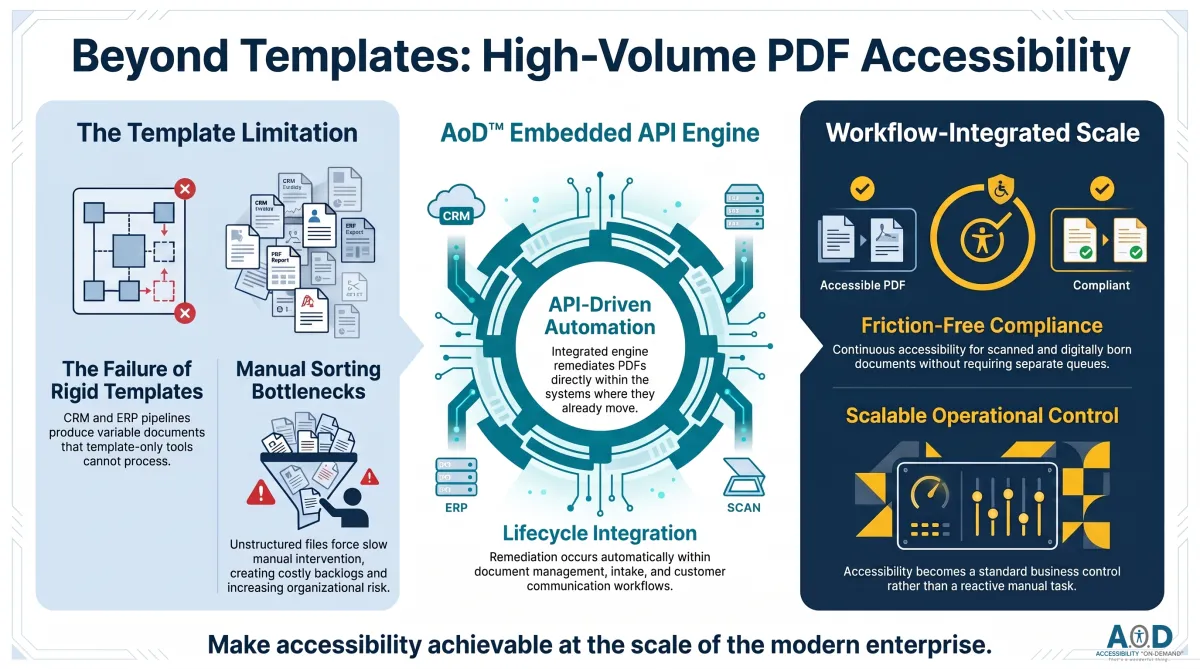
Enterprise PDF accessibility is rarely a template problem.
Documents come from ERP systems, CRM platforms, document-management systems, claims and case tools, shared drives, legacy repositories, scanners, third-party portals, and employee-created files. Some are generated from repeatable processes. Many are highly variable. Some are digitally born PDFs. Others are digitized records, scanned correspondence, forms, statements, reports, and archival documents.
The one thing they have in common is volume.
For organizations responsible for accessible information, the challenge is not making one well-structured PDF compliant. The challenge is remediating large, continuously changing populations of PDFs, regardless of how they were produced, what their layout looks like, or whether they fit a predictable template.
That is the problem AoD is built to solve through its API.
Accessibility Must Work Beyond Structured Templates
Template-driven document generation has its place. Many organizations produce recurring statements, invoices, notices, and reports from standardized systems. But that is only one part of the enterprise document landscape.
Most document populations are more complicated:
Files originate from different departments, applications, vendors, and acquisition channels.
Layouts vary widely from one document to the next.
PDFs include complex tables, forms, images, signatures, scanned pages, mixed content, or inconsistent reading order.
Historical records are often digitized from paper rather than created electronically.
New files move through established workflows without ever passing through a centralized authoring or accessibility-review process.
A remediation approach that depends on a consistent template, a clean source file, or a manual preparation step is not designed for this reality. It may work for a narrow, controlled set of documents, but it becomes difficult to operationalize when document formats are unpredictable and document volume continues to grow.
AoD's API is designed for the broader use case: high-volume PDF remediation across structured and unstructured document populations.
The Real Enterprise Requirement: Workflow-Embedded Accessibility
The question for a CIO, CTO, enterprise architect, or accessibility leader is not simply, "Can this vendor remediate a PDF?"
The more important question is:
Can this capability become part of the systems and workflows that already create, receive, manage, and distribute our documents?
AoD supports accessibility remediation within the enterprise document lifecycle through its API. Rather than requiring users to export files, upload them to a standalone portal, wait for remediation, download them, and manually return them to the originating system, AoD can be called directly from the systems where documents already move.
That means accessibility can be introduced where documents already move:
Document-management systems and content repositories
Customer relationship management platforms
Enterprise resource planning systems
Case-management and claims-processing workflows
Correspondence and customer-communications platforms
Records-management environments
Intake, scanning, and digitization pipelines
Publishing, approval, and distribution processes
Through API integration, remediation can occur as part of the normal document lifecycle. The accessibility step becomes part of the organization's established operational controls rather than a separate task that employees must remember to initiate.
Manual remediation workflows rarely remain reliable at scale. When teams are busy, documents are urgent, systems are disconnected, and ownership is distributed across departments, manual export-and-upload processes create friction. Friction creates exceptions. Exceptions create backlogs. And backlogs increase risk, cost, and time to delivery.
Why Unstructured PDFs Change the Equation
Standardized documents are easier to automate because their content and layout are predictable. But accessibility programs cannot be built around the assumption that every document will be standardized.
Consider a public-sector agency, healthcare organization, insurer, bank, university, or large enterprise. Its document inventory may include:
Scanned letters and historical correspondence
Digitized case records
Multi-page forms and supporting attachments
Individually authored reports
Variable customer communications
Vendor-supplied PDFs
Legal, financial, operational, and compliance records
Documents generated by multiple legacy and modern systems
These documents do not necessarily share the same layout, source application, or structure. A workflow that only works when files conform to a known template leaves the organization with a second, more difficult problem: everything else.
AoD’s API addresses that broader operational challenge by supporting remediation across diverse PDF types and layouts. This allows organizations to build an accessibility process around the documents they actually have, not only the documents that are easiest to standardize.
Embed Accessibility Into DMS, CRM, and ERP Workflows Through the AoD API
Enterprise systems already govern how documents are created, routed, stored, approved, and delivered. AoD's value is its ability to fit into that environment through its API.
For example, a PDF may be:
Ingested into a document-management repository
Generated by an ERP or CRM process
Produced as part of a customer correspondence workflow
Scanned into a records-management system
Routed for review and approval
Prepared for external publication or distribution
With accessibility remediation embedded in the workflow via the AoD API, the file can be processed before it reaches the next stage of its lifecycle. The accessibility step becomes part of the organization's established operational controls rather than a separate task that employees must remember to initiate.
The Limitations of Standalone Remediation Models
Many alternate solutions can remediate individual documents. That is not the same as being able to support enterprise-scale accessibility operations.
When confronted with high volumes of unstructured or variably formatted PDFs, alternate approaches may require one or more of the following:
Manual document sorting and preparation before processing
Separate upload and download workflows
Reliance on standardized templates or repeatable source files
Extensive downstream review and remediation
Human intervention for large portions of the document population
A separate accessibility queue outside the system where the document originated
Repeated handling as new files arrive from the same workflows
Each handoff adds time. Each exception adds cost. Each separate queue makes it more likely that documents will bypass the accessibility process altogether.
The issue is not that downstream remediation is never needed. Legacy archives, unusual files, complex documents, and documents created outside governed workflows will always require an appropriate remediation path. The issue is whether an organization has a scalable way to process the ongoing flow of documents without creating a permanent and expanding operational bottleneck.
AoD enables that process to be embedded closer to the point where documents enter, move through, and exit the enterprise through its API.
High Volume Should Not Mean High Friction
High-volume remediation is often discussed as a throughput issue: how many documents can a vendor process?
But throughput alone is not enough.
A solution must also handle variation. It must work when a document arrives as a scan, a digitally born PDF, a multi-page form, a customer letter, a variable report, or an unstructured archival record. It must fit into existing systems without forcing organizations to redesign every workflow around a standalone remediation tool.
That is what makes AoD different.
AoD enables organizations to move accessibility from a reactive, document-by-document cleanup exercise toward an integrated enterprise capability through its API. Whether PDFs are created by an ERP, managed in a DMS, associated with a CRM record, received through an intake process, or digitized from historical paper files, remediation can be incorporated into the document flow.
The objective is not to assume every document is a template.
The objective is to make accessibility achievable at the scale and complexity of the modern enterprise.
The Business Case
A document-remediation strategy should be evaluated by more than the cost to process a single file.
Organizations should consider:
How many PDFs enter the business each month?
How variable are their formats and sources?
How many documents require manual sorting or intervention before remediation can begin?
How often do users need to move files between systems?
How much time is lost returning remediated documents to their original repositories or workflows?
How much downstream work remains after the initial processing step?
Can the solution operate inside the systems employees already use?
The more unstructured the document population, the more important workflow integration becomes. A process that works only for clean, repeatable, template-based output may leave the organization maintaining multiple accessibility programs: one for predictable documents and another for everything else.
AoD’s API helps eliminate that divide by supporting high-volume remediation across the full range of enterprise PDFs.
About Accessibility on Demand™
Automation-first by design, not by compromise. Delivering compliance, speed, and cost-savings in one solution.
Accessibility on Demand™ (AoD) is an enterprise-grade, AI-powered PDF remediation platform designed for automation-first accessibility workflows, helping organizations make inaccessible PDFs compliant, audit-ready assets at scale without operational friction.
For organizations where accessibility is a strategic priority, AoD brings precision, speed, and control to a process that is too often fragmented and costly. It converts PDFs into WCAG 2.1 Level AA, PDF/UA, ADA, and Section 508-aligned documents in minutes, with up to 95% automation, delivering both measurable cost reduction and defensible compliance evidence.
Built for CIOs, IT leaders, and accessibility teams, AoD replaces labor-intensive remediation with intelligent automation across OCR, document structure tagging, reading order, meaningful alternative text, complex tables, formulas, and fillable forms. The result is a refined, scalable compliance operation that supports consistency, efficiency, and long-term governance.
AoD deploys as a self-service portal or integrates directly into enterprise document management and intelligent document processing pipelines via API, embedding accessibility upstream and preserving continuity across existing workflows.
AoD serves organizations across SLED, healthcare, federal government, higher education, financial services, insurance, and legal sectors, where document complexity is high, compliance expectations are rising, and the cost of inaccessibility is meaningful.
For organizations navigating ADA Title II, ADA Title III, Section 504, Section 508, AODA, and evolving accessibility requirements, AoD offers a partner-neutral path to compliance defined by precision, scalability, and measurable business impact.
Enterprise capabilities
API integration for upstream remediation within existing workflows and IDP stacks.
High-volume batch processing for large files and repositories.
Third-party validation with WCAG and PDF/UA compliance scoring.
Section 508- and ADA-aligned outputs with audit-ready reporting.
Dedicated account management and enterprise support.
Comprehensive onboarding and platform training.
For remediation professionals
For remediation professionals, AoD is built for the scale of what comes next. It handles the majority of the heavy lifting, including automated tagging, reading order, contextual alt-text metadata, and document structure, then delivers a complete tag tree so specialists can focus on the judgment, nuance, refinement, and governance decisions. At the center of accessibility is one essential truth: documents must be genuinely usable for the people who depend on them. Together, we can take on the trillions of pages ahead and raise the standard for what accessibility can be.
Beat the Deadlines: Talk with a PDF Accessibility Specialist
The bar for IT accessibility in the public sector is rising. If your organization is navigating ADA compliance, WCAG requirements, or Section 508 accessibility and struggling to understand what applies to your PDF documents. Discover how AoD can ensure your organization stays ahead of accessibility deadlines, clarify scope, risk, and next steps.
Convenient External Links to learn more:
Visit our Homepage and watch the AoD Demo (2min 33sec)
Learn more about PDF fillable form remediation and watch the AoD PDF fillable form demo (9min 9sec)
Enjoy AoD's Blog: Accessibility Insights
To Sign-up for a free trial of AoD or need help navigating ADA Title II regulations, visit: Book a Demo
External Links to Additional Resources:
W3C: Web Content Accessibility Guidelines (WCAG) 2.1
Section 508 Standards: https://www.section508.gov/
ADA: Exceptions
First Steps Toward Compliance: https://www.ada.gov/resources/web-rule-first-steps/
DOJ Title II Web Accessibility Final Rule: https://www.ada.gov/resources/2024-03-08-web-rule/
